The AI Data Center Water Management Challenge:
A Georgia Case Study
We recently partnered with the DataedX Group to develop a report on the impact of AI data centers on Georgia’s water resources. The professional report is available on the DataedX website. You can read the underlying academic paper on this page, or download a pdf of it at the button below.
The AI Data Center Water Management Challenge: A Georgia Case Study
Masheika Allgood Joy Victor Brandeis Marshall
AllAI Consulting, LLC[1] DataedX Group DataedX Group
Abstract
AI data centers have become a flashpoint for community activism in cities across the US and around the world. Much of the discussion is centered around the enormous amounts of resources these facilities consume. Electricity has been the focal point of the discontent, with rising bills serving as the impetus for the current wave of community activism. But water consumption is quickly becoming a centerpiece issue. While there is ample research into the abstract notion of AI data center water use, and some concrete research into the math around the amount of water required by generative AI processes and the AI data centers that host them. However, there has not been a study that considers the full range of water-related risks for communities hosting AI data centers. In this paper, we focus on the impact of Scope 1 data center water use on water infrastructure in the State of Georgia. We consider the feasibility of implementing cutting edge innovations in both in-facility and rooftop cooling systems in Georgia’s climate and whether Georgia’s unique water source constraints allow for effective water replenishment at scale. We then delve into the impact AI data centers have on Georgia’s wastewater treatment infrastructure. We consider the various ways that facilities water use impacts surrounding communities. Finally, we provide technical recommendations for governments who are endeavoring to create legal requirements intended to encourage data center operators to increase water sustainability without sacrificing energy efficiency along with broader governance recommendations intended to help policymakers and regulators identify and address water and wastewater infrastructure and planning gaps.
Introduction
AI data centers require significant resources to operate. Power is often the primary concern for developers and government, but water is increasingly being recognized as a fundamental data center input.[2] There is an entire body of research that delves into how water consumptive generative AI processes are and how that translates to the data centers that host those processes. But that research generally considers genAI water usage in the abstract, none of it places that consumption within the context of the communities that host AI data centers. This paper seeks to fill that gap by directly considering the impact of AI data centers on communities in and around the Metro Atlanta region in the state of Georgia.
Georgia has quietly become one of America’s AI data center markets. Investment began ramping up in the first half of 2017, with Atlanta seeing $18.2 billion in data center investment[3] which led to 7.5MW of capacity under construction by the end of the year.[4] Metro Atlanta’s aggressive use of tax incentives coupled with cheap land and low power costs led to a boom in data construction.[5] By late 2020, the Metro Atlanta Region was the seventh largest data center market in the nation.[6] In 2025, Metro Atlanta was the second largest data center market in the US, with nearly 50% more current or under construction inventory than the third largest market (Dallas-Fort Worth).[7]
The long-term success of Georgia’s current and proposed data center buildout will largely be determined by the state’s ability to manage the water demands of these AI data centers. But the Metro Atlanta region, the locus of Georgia’s build out, is a water-constrained region. According to the regional water management district:
· The region’s watershed is one of the smallest of any major metro region in the country, with Metro Atlanta sitting at the headwaters of six small river systems.
· We rely almost entirely on surface water (rivers and lakes) — access to groundwater is constrained by the region’s granite bedrock.
· Georgia is prone to drought and drought-like conditions, with these events increasing in frequency over the past 20 years.[8]
These seemingly divergent paths - scarce water resources and a massive AI data center build out - are what we look to explore in this paper. We ground the paper in a discussion of how, why, and to what level AI data centers use water. We consider new innovations in AI data center water sustainability and consider which, if any, are applicable to the state of Georgia and the Metro Atlanta region. We then turn to water infrastructure management considerations and map out who is in charge, in what capacity, and highlight the key planning processes used to manage Georgia’s water on the local, regional, and state levels. Our report is centered on the following two research questions:
1. Is there a mix of technological requirements GA could demand that would increase water sustainability without sacrificing energy efficiency?
2. What kinds of infrastructure improvements are required for protecting GA's waters from discharge and over-pumping?
We implemented a 3 pronged research methodology to address our lines of inquiry. The core methodology was gathering publicly available government data, academic research, and vendor information. Every reference that is cited in this paper is openly available online. We also attempted to engage in a comprehensive in-depth interview process and reached out to interviewees at six different agencies that have some level of water management responsibility at the state, regional, or local level. We had a 27% response rate to our recruitment emails (with one candidate simply responding – “No.”), and were unfortunately only able to interview 13% of the respondents we targeted. Finally, we used small case studies to buttress our analysis.
The report’s key finding is that the breakneck
speed of Georgia’s AI data center buildout is outpacing the state’s water
infrastructure planning, to an unsustainable degree. Innovations in data center
water sustainability are insufficient to address the main drivers of AI data
center water consumption and Georgia, particularly the Metro Atlanta region, is
not geographically suited for current water replenishment technologies.
Wastewater management facilities have sufficient current and planned capacity to
manage large-scale AI data center discharge, but they do not have the technical
capability to treat the somewhat novel mix of chemicals that discharge
contains. At each stage of the report, we consider the community impact of the
infrastructure and planning gaps that have been uncovered. The impacts of these
gaps will definitely be acutely felt by Metro Atlanta communities, but there is
a significant risk of them spreading to communities all across Georgia as the
second wave of the data center build out moves across the state. We discuss
many of these impacts in detail and provide recommendations to water management
authorities to assist them in incorporating the particular needs of AI data
centers into their management and planning processes.
Table of Contents
Intro to data center cooling
- Scope 1
Relationship between water
and electricity in data center cooling
Innovations in data center
cooling
Nature and scope of data
center wastewater discharge
Cooling tower blowdown
chemical mix
Is Georgia's current and
planned water infrastructure capacity sufficient to meet demand
District drinking water
capacity
District wastewater
treatment capacity
Private well water quality
and availability
Spills and service
disruptions
Who is managing these new
risks
Water and Wastewater
Management Organizational Structure
How the management bodies
intersect
List of Figures
Figure 1: GPU Value Cascade.......................................................................................................... 7
Figure 2: Cooling system image...................................................................................................... 8
Figure 3: Rear-door heat exchanger....................................................................................... 10
Figure 4: Direct to chip liquid cooling (DLC)...................................................................... 11
Figure 5: Immersion cooling......................................................................................................... 11
Figure 6: Two-phase DLC............................................................................................................... 12
Figure 7: Google’s Yearly Global Water Use...................................................................... 25
Figure 8: Map of Metropolitan North Georgia Water
District................................. 32
Figure 9: Managed Aquifer Recharge Process..................................................................... 35
Figure 10: Water Sources - Metro Atlanta Region.......................................................... 36
Figure 11: Map of Data Centers and Wastewater
Treatment Plants in Fulton County Georgia....................................................................................................................... 38
Figure 12: Atlanta Region Water Usage Chart (2014).................................................. 42
Figure 13: Atlanta Counties Projected Monthly Utility
Bills (2025-2030)...... 48
Figure 14: Map of Current and Planned Georgia Data
Centers................................. 49
Figure 15: Map of Georgia’s Water Planning Regions..................................................... 51
Figure 16: Georgia Water and Wastewater Management
Entities Responsibility Venn Diagram........................................................................................................................... 53
List of Tables
Table 1: Water Replacement Chemicals for
Low or Zero Water Cooling Systems
Table 2: Ambient Temperature
Requirements for Rooftop Cooling Innovations
Table 3: Pre-Treatment Cooling System
Chemical Additives
Table 4: Operational Cooling System
Chemical Additives
Table 5: Yearly Data Center Water Usage
- Google Data Center, Douglas County Georgia
Table 8: Blowdown Chemical Toxicity
Chart
Table 9: Georgia Water and Wastewater
Management Entities
Is there a mix of technological requirements GA could demand that would increase water sustainability without sacrificing energy efficiency?
Intro to data center cooling - Scope 1
Traditional data center facilities have used air cooling for decades without incident. But modern data centers are fundamentally different. AI data centers are built to power generative AI workloads. GenAI is the version of AI that is used in most of the programs and apps you interact with. From ChatGPT and Claude, to DALL-E, to the genAI summaries at the top of your search engine and the AI assistant in your tax preparation software. Modern data centers are built to power generative AI, and that makes them work fundamentally different than traditional data centers.
GenAI workloads run on advanced GPU’s that operate at extremely high temperatures and are intended to run 24/7. For example, the GPU that is powering xAI’s Grok - NVIDIA’s H100 - runs at an average temperature of 188 degrees Fahrenheit and has a max operating temperature of 208F.[9] The GPUs are designed to slow down their processing when they reach 203F, and shut down when they reach 208F. If they run too long at the hottest temperatures, they fail and have to be replaced prematurely. But replacing an AI GPU isn’t like replacing a lightbulb, or a laptop.
The types of GPU’s that run genAI workloads are massively expensive to purchase, a single GPU can cost upwards of $50,000 and has a projected lifespan of 4 to 6 years. Companies run tens of thousands to hundreds of thousands of these GPUs in each AI data center. The data center that powered xAI’s Grok, and is now powering Anthropic's Claude, is running 220,000 NVIDIA H100 GPUs.[10] Of the billions of dollars that data center operators are spending on AI-related capital expenditures, “GPUs account for 60-80% of total cost of ownership.”[11] So it is critical for data center operators to extend the lifetime of these essential components for as long as possible.
It is for this reason that facility operators are attempting to create a 'GPU Value Cascade.'[12] As depicted in the graphic below, this is a method for extending a GPU's lifespan by progressively moving it to lower demand workloads over time.
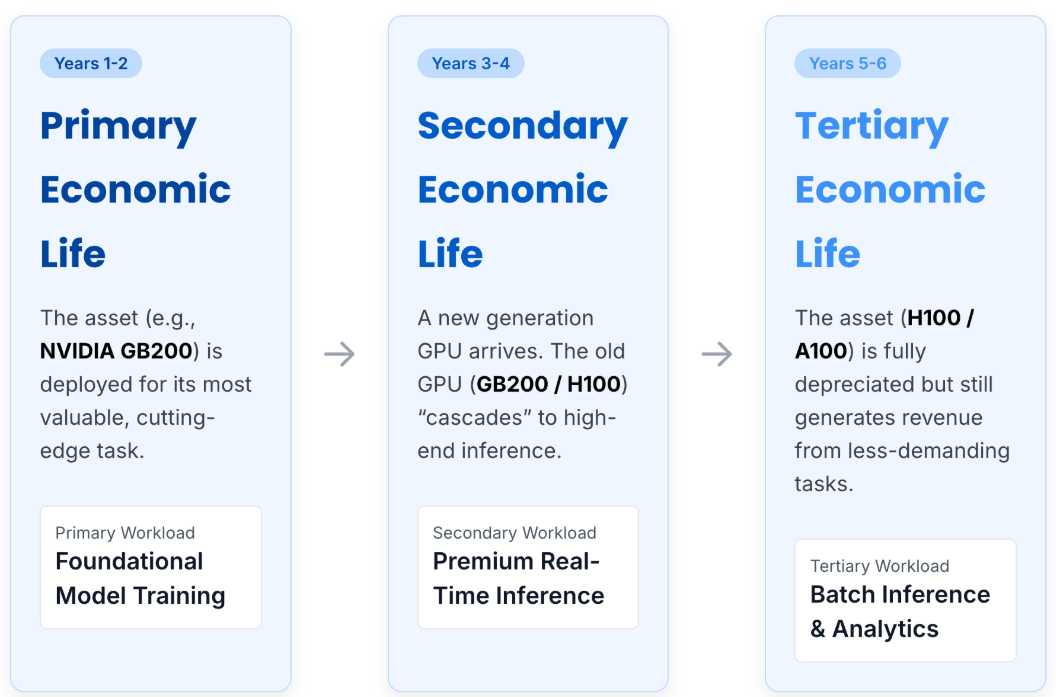
Figure 1: GPU Value Cascade[13]
However, training genAI models is a hardware-intense process that requires the GPU’s to be run at a relatively high intensity - 60-70% of maximum - during the Primary Economic Life phase. The scant amount of publicly-available expert information on GPU life expectancy indicates that the actual lifespan for an AI GPU, given the high initial utilization rate, is one to three years.[14] Which is why facility operators allocate so much of their capital costs and operating budget to relieving heat-related stress on the GPUs.[15] They are trying to extend the lifecycle of each chip as far as possible.
Ensuring that each GPU is operating as close to the optimal operating range as possible at all times is the main method for facility owners to keep the GPUs running as efficiently as possible during every phase of the value cascade, allowing them to get the highest return on their investment. This is why cooling systems are critical systems for modern data center facilities. So, how do these systems work?
Relationship between water and electricity in data center cooling
Modern data
center cooling is a 3 step process. Two of the processes happen within the
facility and one process happens on the facility roof. The image below
illustrates these processes. First, the in-facility server cooling system pulls
heat out of the server and routes it to the heat exchanger. Then the heat exchanger
carries the heat from the in-facility server cooling system up to the roof.
Finally, the rooftop systems push the heat from the heat exchange loop into the
surrounding environment. 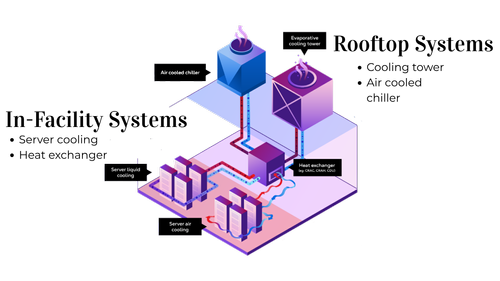
Figure 2: Cooling system image[16]
As you can see in the image, there are two options for server and rooftop cooling systems. Server cooling systems can either be liquid or air cooled. Rooftop systems can either utilize air cooled chillers or cooling towers. Air cooled chillers are essentially industrial air conditioning, they use electricity. Cooling towers work by evaporating water. Water and electricity have an inverse relationship when it comes to data center cooling. The less water you use (cooling towers), the more electricity you have to use (air chillers), and vice versa.[17] Any discussion of data center water consumption has to start with the recognition that lowering water consumption (relying less on cooling towers), means increasing electricity consumption (relying more on air cooled chillers).
Traditional data centers are almost exclusively cooled by electricity-driven processes both in the facility and on the roof. But modern data centers are the exact opposite, almost exclusively favoring liquid-driven processes within the facility and relying heavily on evaporative cooling on the roof. The shift has been driven by the difference in the level of heat produced within AI data centers. Air conditioning can’t keep up with these levels of heat, at least, not in an energy or cost-efficient way.[18] The amount of energy and space that would be required for an air cooling system to be effective in an AI data center would significantly impact the facility operator’s ability to generate revenue.[19] Liquid cooling is incredibly more efficient, with a much smaller footprint. “Water transports 3,500 times more heat from a CPU or GPU than air and has 25 times the thermal conductivity.”[20] This is why data centers have moved to liquid cooling as the industry standard, with industry analysts predicting that “over 50% of new hyperscale capacity will be liquid cooled” by 2027.[21]
But air cooling isn’t dead, it just isn’t the preferred primary cooling method for modern data centers. Air cooling systems will always have a role in data center cooling because they’re cheaper and less technically complicated to set up, maintain, and modify than liquid cooling systems.[22] Also, when using direct-to-chip cooling, only the GPU is cooled. The other components in the server, which also heat up during operation, aren’t being directly cooled by the liquid cooling system. Instead, the non-GPU components rely on traditional air cooling to maintain their operating temperatures.[23] Which is why many facility operators are opting for hybrid cooling solutions within the facility, deploying both air and liquid cooled systems for AI servers.[24]
The in-facility cooling system is only one of the air v. liquid decisions the facility operator must make. They also have to decide which method they want to use for the heat exchange system on the roof. There are two key technologies for data center heat exchange - air cooled chillers (electricity), or evaporative cooling towers (water). Either of these rooftop systems can be used to exchange heat from your closed loop direct-to-chip cooling system.
Ultimately, the choice of heat exchange technology is the greatest determinant of a facility’s level of water consumption. But, in order to better understand why, we should first look at the current technological landscape for data center cooling. Specifically, innovations that are targeted at making liquid cooling systems less water consumptive.
Innovations in data center cooling
In-facility innovations
Most discussions around data center water efficiencies focus on in-facility innovations. Closed loop is a term that is often used in this discussion, but it’s less of an innovation and more of an industry best practice. While open cooling systems are still used in traditional data centers, the intense cooling required by the dense GPU rack configurations that are standard for genAI workloads renders open cooling systems useless. So closed loop systems are the standard for modern data centers. Cooling innovations have been largely focused within the liquid cooling technology space. Specifically, innovations in how the liquid is delivered to the hardware and the type of liquids used in the closed loop.
There have been three major innovations in how cooling liquid is delivered to the hardware - Rear-Door Heat Exchangers, Direct-to-Chip Liquid Cooling (DLC), and immersion cooling, which are depicted in the images below:
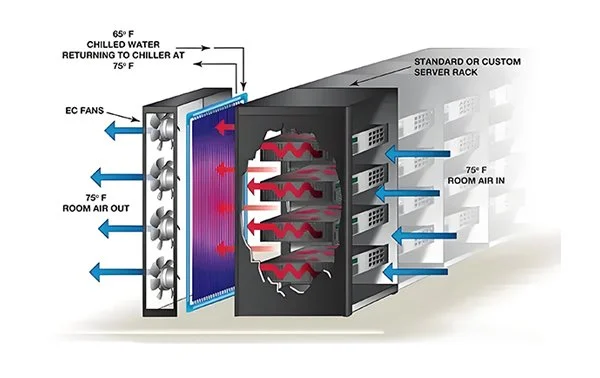
Figure 3: Rear-door heat exchanger[25]
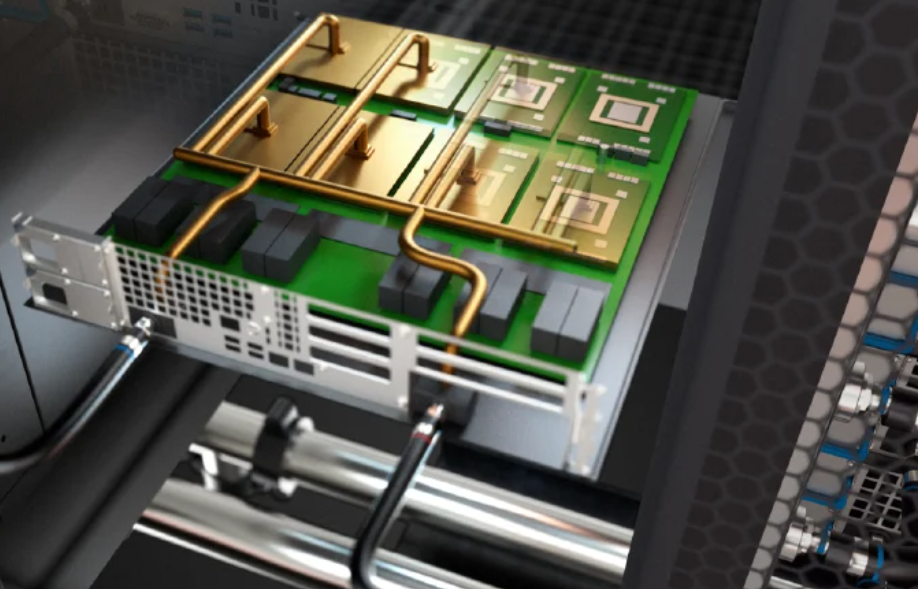
Figure 4: Direct to chip liquid cooling (DLC)[26]
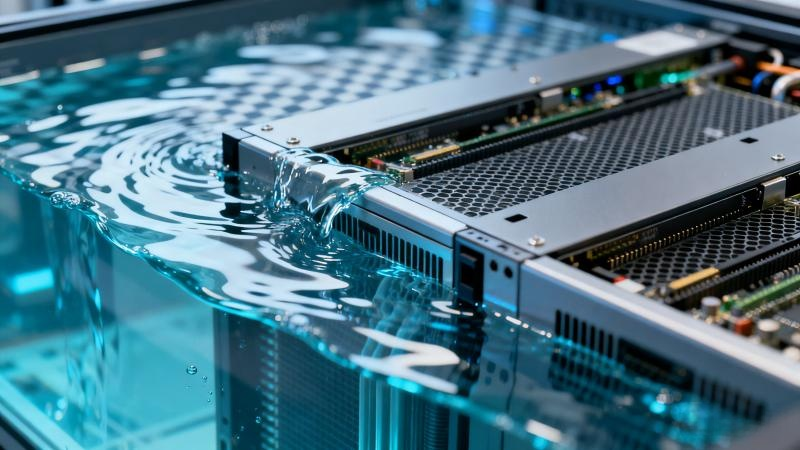
Figure 5: Immersion cooling[27]
Rear-Door Heat Exchangers replace the back panel of a server with a liquid-cooled coil.[28] The exhaust air from the server passes through the coil, and the heat is transferred to the liquid in the coil.[29] DLC involves running liquid coolant directly onto the surface of the GPU.[30] Immersion cooling systems sit the entire server inside of a liquid solution.[31] Rear-Door Heat Exchange and DLC systems can either utilize a mix of propylene glycol and water, or treated and deionized water. This minimizes the need for water within the closed loop, which is why these systems are sometimes referred to as low-water cooling systems.
Immersion cooling tanks are filled with dielectric fluorocarbons.[32] Since no water is used in the closed loop that feeds the tanks, this is considered a zero or no-water cooling solution. There is a new no-water cooling solution that is currently being tested called Two-Phase Direct-to-Chip Cooling.
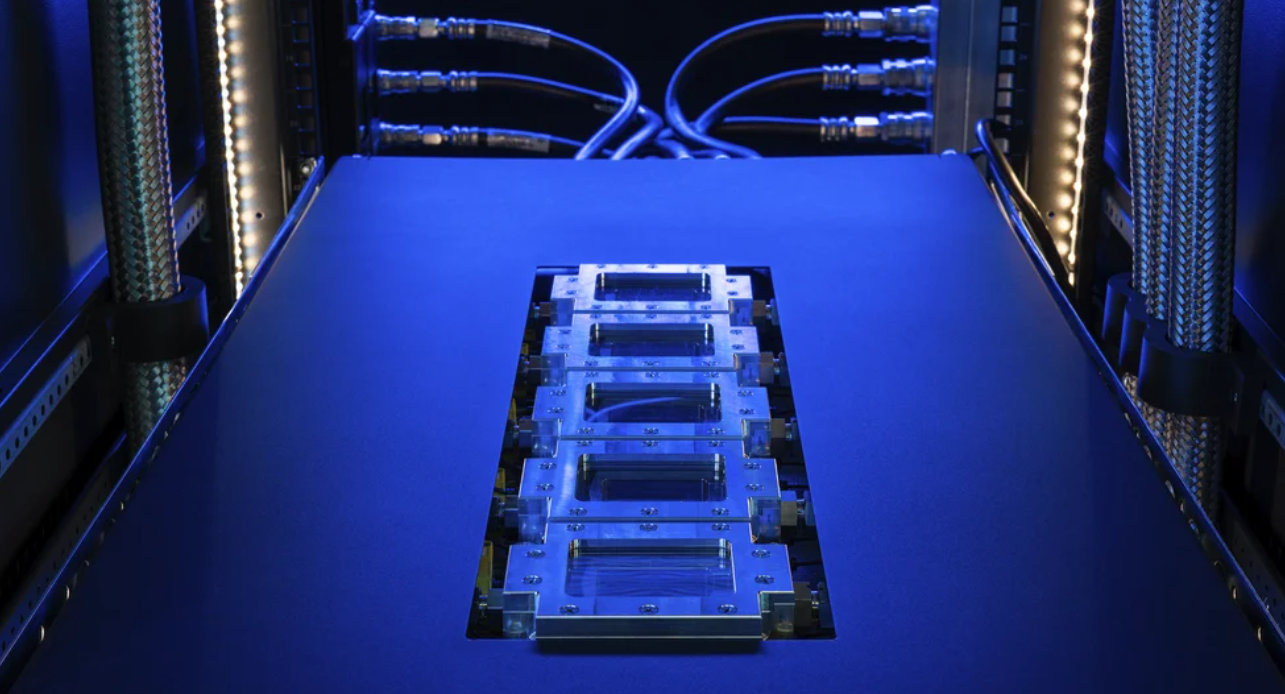
Two-Phase DLC places a specially formulated fluid in the cold plates that sit on top of the GPU, and uses the heat from the GPU to boil the fluid, changing it from liquid to gas.[34] The gas then goes through a heat exchange loop to cool it back into a liquid, where it goes back through the process again. Since the physics of the process doesn’t work with water, the only liquid in the closed loop is the specially formulated dielectric liquid.[35]
Top of facility innovations
The most discussed cooling innovations are the in-facility innovations. These methods are meant to lower or eliminate the amount of water used in the cooling system's closed loop. But the closed loop is not where most of a cooling system's water is consumed. The closed loop requires significant liquids to fill at system startup, but then those liquids run in and endless loop with very little loss. The roof is where data center water consumption primarily happens, through the evaporative heat exchange process.
There are two types of rooftop heat exchange technologies - cooling towers and air chillers. Cooling towers work by spraying the heated facility water onto an air-cooled porous material called a “fill.” As the water cools, most of it turns to steam and is pulled into the outside environment via fans at the top of the tower. Any cooled water that remains falls through the fill and continues back through the in-facility heat exchange loop.[36]
Air chillers utilize a refrigeration process, just like your air conditioner in your home. They transfer the heat from the facility into a refrigerant fluid, and then use fans to cool the refrigerant and push the heat into the surrounding environment.
Air chillers and cooling towers can be used separately or in combination, and both can be used with either air or liquid in-facility cooling systems. So, just like in-facility cooling, rooftop cooling technologies present facility operators with a choice between water or electricity consumption. The same efficiency issues are also present on the roof, with cooling towers being more efficient per square feet than air chillers. But, unlike the in-facility decision making, the rooftop choice is not binary. Neither the water or electricity based solution can be completely depended upon in isolation.
Air chillers require intense amounts of energy and significant numbers of fans to perform at a fraction of the cooling strength of a cooling tower. The largest air cooled chillers use 18 fans to cool up to 2MW of facility energy, whereas “a single datacenter evaporation tower can typically cool ~7-8MW for large units.”[37] However, evaporative cooling has environmental constraints as it works most efficiently when the relative humidity is low - preferably under 30%.[38] So, just like in-facility cooling systems, operators are opting for a hybrid setup in their top of facility cooling systems. Facility operators are increasingly setting up a primary and backup relationship between the two systems and navigating the limitations of the technology types by switching between them as conditions dictate.
In addition to facility operators innovating around system management, they have also benefitted from some technical innovations in the heat exchange space. Specifically, the use of 'free cooling' to reduce the load on the cooling systems, minimize the consumptiveness of evaporative cooling, and minimize the amount of drinking water used in the heat exchange loop. Free cooling is when facility operators use outside air temperatures to lower the overall heat within the facility. Free cooling systems don't perform any server-level cooling, they operate separately from the facility's closed loop cooling system. Instead, free cooling systems are used to manage the heat that is generated by all of the other equipment in the facility, which reduces the overall load on the rooftop cooling systems.
The one free cooling innovation that is targeted at addressing evaporative water consumption is adiabatic cooling. Adiabatic cooling combines free cooling and evaporative cooling to minimize the amount of water and energy used to remove heat from the facility.[39] Large fans are used to pull warm outside air through water-moistened pads. As the water in the pads evaporates, it cools the air.[40] That cooled air is then pushed into the facility where it is used to manage the heat within the facility.[41] Unlike cooling towers which require a constant stream of water, adiabatic cooling systems only require water when the temperature is too high for free cooling.[42] This flexibility to shift between free and evaporative cooling is how this innovation drives down rooftop water consumption.
Economizers are a class of free cooling innovations that utilize a series of fans and pumps to either pull ambient air directly into the facility (air-side), or to push ambient air through a refrigerant or evaporative heat exchange process that uses cooler outside air to remove the heat from the facility (water-side or refrigerant-based).[43] Economizer effectiveness is wholly dependent on outside temperature.
Water-side economizers are often operated in conjunction with rooftop cooling tower systems. Water-side economizers take advantage of cold outside air to replace the chiller function within the evaporative cooling system. These are also considered indirect economizers since they don't pull outside air into the facility. In evaporative cooling systems, once the cooled water exits the cooling tower and heads back through the heat exchange loop, it has to be pumped through a chiller to bring it to the exact temperature required to extract heat from the closed loop. This chiller process is the most energy-intensive part of the evaporative cooling system. Water-side economizers replace the chiller function, using outside air to cool the returning water from the cooling tower to the level required for the heat exchange.[44] Replacing the chiller function with a pressure-driven heat exchange process[45] allows for facility-level evaporative cooling at a fraction of the electricity costs. But the outside air temperature has to be below 35F for these systems to work.[46]
Direct air-side economizers pull cool outside air directly into the facility. These systems can operate whenever the outside air temperature is below 70F.[47] The key limiting factors for air-side economizers are the level of humidity and pollution in the outside air, both of which can damage the sensitive equipment inside of the data center.[48]
Refrigerant-based economizers take advantage of cold temperatures to replace the compressor function within the air conditioning system. These are considered indirect economizers since, just like water-side economizers, no air gets pulled into the facility. when the temperature of the outside air is lower than the facility's air conditioned temperatures, refrigerant-based economizers replace the rooftop air conditioning compressor with a low-energy refrigerant pump.[49] That way the system isn't cooling already cold air, it's just pumping it to where it needs to go. Since the compressor is the major driver of electricity use in an air conditioning system, replacing it with a much lower power refrigerant pump allows for facility-level air conditioning at a fraction of the electricity costs. But the outside air has to be below 50F for these systems to work.[50]
The core function of economizers (air, refrigerant, and water-based), is to minimize a facility's electricity bill. They are not designed to mitigate the level of water consumption of evaporative cooling systems. And while adiabatic cooling systems are less energy-intensive than air chillers, they are still more energy-intensive than cooling towers. So, despite the proliferation of energy-focused innovations, evaporative cooling towers are still the preferred primary cooling method for AI data centers, due to their superior effectiveness and lower energy costs.[51] In the absence of any innovations targeted at mitigating the staggering amounts of water evaporative cooling towers require and consume, facility operators are actively trialing innovations in water sourcing in an effort to at least replace drinking water as the primary source of water for cooling tower use.
Innovations in water sourcing
Data center operators need access to hundreds of thousands to millions of gallons of water per day to keep their facilities running at optimal temperatures. Of the various types of municipal water sources that are available at that volume, drinking water is by far the most reliable and highest quality source. Reliability is important because the volume of consistent water flow required by these cooling systems is substantial. A large evaporation tower that can cool 7-8MW of facility power load requires water to flow into the tower at a rate of 5 gallons per minute.[52] That’s 7,200 gallons of water per day for a single cooling tower. The average American uses 82 gallons of water per day,[53] which means that each day the cooling tower runs it uses as much water as 87 people. And unlike humans, who return what we use to the system through the sink, tub, and toilet, cooling towers evaporate 80% of the water they intake. The water the cooling towers evaporate is lost - most of it being carried on the breeze to other states and countries as evaporation. The other 20% is flushed out of the system as blowdown that is too polluted to return to the cooling system or the municipal drinking water system. So, each large cooling tower removes 70 people worth of water from the local drinking water system through evaporation every day it runs.
Drinking water is scarce in the US,[54] and in Georgia.[55] And it’s getting scarcer every day. So why do data center operators use drinking water? Because of the quality. Cooling tower water needs to be within specific conductivity and mineral content ranges to effectively remove heat without destroying the sensitive equipment in the cooling system. Specifically, the water must be within the following quality ranges:
● Total dissolved solids (TDS): Target range of 500-1,500 mg/L for most cooling tower systems. Higher TDS concentrations increase scaling potential and corrosion rates. Municipal wastewater typically ranges from 600-1,200 mg/L TDS after secondary treatment.
● Hardness: Calcium and magnesium concentrations should remain below 200-400 mg/L as CaCO₃ to minimize scale formation. Softening or scale inhibitor programs manage hardness in source water exceeding these levels.
● Suspended solids: Cooling water specifications typically limit suspended solids to 10-25 mg/L. Particulates cause fouling in heat exchangers and promote microbial growth in cooling towers.
● Biological content: Total coliform and heterotrophic bacteria counts must be controlled to prevent biofilm formation. While absolute sterility isn’t required, bacterial counts should remain below 10,000 CFU/mL through continuous disinfection.
● pH and alkalinity: Optimal pH ranges from 6.5-8.5 for most cooling systems. Alkalinity between 50-200 mg/L as CaCO₃ provides buffering capacity while limiting scale potential.[56]
Of the available municipal water sources, drinking water is the closest to meeting the high quality standards required by data center cooling systems. Facility operators build filtration and water treatment systems within the facility to bring the water up to the necessary quality before it enters the cooling systems. Drinking water is highly regulated at the federal level in the US, which means that the water quality parameters are similar all over the country. This standardization has allowed vendors that serve the data center industry to develop standard products and systems for facility water pre-treatment systems.
Using a different water source means that the standard products and systems won’t work as-is. Facility operators would need to add additional or new products and systems to manage increased pollution levels, or entirely new contaminants. Which means increased water treatment costs for the facility. In addition to price sensitivity for treatment costs, facility operators are also sensitive to the costs of the water itself. To ensure manageable operating costs, facility operators prefer to procure water from sources with cost profiles that are equal to or lower than municipal drinking water.
There are three key innovations in data center water sourcing: reclaimed water, rainwater harvesting, and desalination. Reclaimed water is wastewater that’s been treated to an acceptable level for non-potable uses.[57] It’s often called purple pipe water because utilities pump reclaimed water through purple pipes to distinguish it from other types of water. Reclaimed water would initially seem to be the most natural replacement source as the infrastructure already exists across much of the US. Currently, US wastewater treatment plants treat approximately 34 billion gallons of wastewater every day.[58] But wastewater treatment has been underfunded in the US for decades.[59] The infrastructure is old, often being operated well past its engineering design date, and facilities are servicing much larger populations than they were designed for.[60] Also, reclaimed water quality is not standard across the US and could require significant upgrades to a facility's pre-treatment systems to account for the industrial residues, heavy metals, and nutrients that are often present in the water.[61]
The second innovation is harvesting rainwater for cooling system use. Georgia permits the use of rainwater for cooling tower purposes and has developed specific guidelines regulating the process.[62] Rainwater harvesting systems are regulated in Chapter 15 of the Georgia State Minimum Standard Plumbing Code (2012).[63] The Code mandates that the rainwater be filtered[64] and disinfected[65] prior to distribution. Research indicates that “it is feasible to use harvested rainwater in cooling systems, including cooling towers,” largely because rainwater has low conductivity and total dissolved solids, key requirements for cooling tower water.[66] While rainwater systems can significantly mitigate drinking water usage and save operators money long-term, they require a significant initial capital investment in tanks, filters, pumps, and other components, “and the maintenance costs can sometimes be as high as installation costs.”[67]
The final 'innovation' is actually a technology that has been around in some form for millennia.[68] Desalination is the process of treating and filtering ocean or brackish river water, and the technology is now being used to create new sources of water for data center cooling. Desalination is often seen as a win-win because it takes water that is completely removed from the system and makes it feasible for commercial or municipal use. But there’s a reason why these water sources are not a part of the commercial or municipal water system - the levels of dissolved solids are extremely high. “For context, pure distilled water would have a TDS reading close to 0 ppm, while seawater can have a TDS level of more than 30,000 ppm.”[69] Seawater also has very high conductivity,[70] which would need to be lowered significantly to make the water suitable for cooling towers. The process for desalinating ocean or brackish water to the level required for use in data center cooling systems, is very energy-intensive due to the significant gap between the baseline water quality and the cooling system requirements.[71] Also, the treatment facilities are built at the scale of a full water treatment facility,[72] which means they take 3[73] to 6[74] years to build.
Desalination plants also produce a concentrated brine that is harmful to aquatic life, can contaminate soil and groundwater, and is complicated and expensive to discharge responsibly.[75] Brine concentrators and crystallizers are new innovations developed to treat brine and separate it into freshwater and salt.[76] However, these technologies are prohibitively expensive to procure and operate, in addition to the costs of the desalination plants, so adoption has been limited.[77]
Community Impact
When considering the utility of requiring the use of specific data center cooling innovations for Georgia data center operators, it is important to consider how these innovations would impact Georgians. What are the tradeoffs communities would be making if these solutions were mandated? The following section will consider the community impact of each category of water mitigation or replacement innovations discussed above.
Low/no-water solutions
These solutions are aimed at replacing all or part of the water in the in-facility closed loop liquid cooling systems. The water would be replaced by one of four different types of liquid, depending on the cooling system that is chosen. For server-level cooling solutions, like rear door heat exchangers, operators can use a 25% glycol-water solution. This allows them to replace a quarter of their in-facility water use with propylene glycol. Direct-to-Chip systems also use propylene glycol, but without any water. Immersion cooling uses either hydrocarbon or fluorocarbon coolants. And some data center operators are using ethylene glycol to replace the water in the heat exchange loop that runs up to the rooftop chiller.
Each of the server or chip-level cooling systems requires hundreds of thousands to millions of gallons of liquid. Which means replacing hundreds of thousands to millions of gallons of water with hundreds of thousands to millions of gallons of possibly toxic chemicals. Fortunately, propylene glycol is generally recognized as safe (GRAS), by the FDA.[78] So the low water solution for rear-door heat exchangers and the no water solution for direct to chip systems present true non-toxic alternatives to the water scarcity issue for communities. However, the same cannot be said for immersion cooling and heat exchange replacement fluids.
Ethylene glycol, which is used to replace water in the rooftop chiller heat exchange loop, is toxic if ingested.[79] That means a spill that soaks into the soil, or directly impacts nearby aquifers, wells, or drinking water sources could cause significant public health concerns. The hydrocarbon oils that are used for single-phase immersion cooling also pose a risk of groundwater contamination if spilled.[80] Additionally, hydrocarbon oils are highly flammable and toxic if inhaled,[81] which increases the scale and scope of property damage and public health risk for the facility that stores them in large quantities. Two-phase immersion cooling uses PFAS, which are better known as forever chemicals.[82] These chemicals have proven to cause a variety of negative health effects from both acute and long-term exposure.[83]
When considering low or zero-water replacement solutions, communities are facing a tradeoff between replacing millions of gallons of in-facility water with millions of gallons of antifreeze, motor oil, or forever chemicals. If any of these chemicals were to spill or catch fire, the risk to public health could be catastrophic in the short term. With possible long-term negative health impacts on host communities.
Table 1: Water Replacement Chemicals for Low or Zero Water Cooling Systems
|
Low
or No water |
Replacement Fluid |
Usage |
Toxicity |
Regulatory Requirements |
|
Low |
Propylene
Glycol |
Rear-Door
Heat Exchangers |
FDA GRAS |
No
special handling required |
|
No |
Propylene
Glycol |
Direct-to-chip
-Single phase |
||
|
No |
Ethylene
Glycol (antifreeze) |
Heat
Exchange loop |
Toxic if
ingested |
EPA
designated Hazardous Air Pollutant.[84] Spills
regulated under the Georgia Hazardous Site Response Act[85] |
|
No |
Hydrocarbon
coolants |
Immersion
cooling |
Toxic if
inhaled |
Regulated
as used oil under the Georgia Solid Waste Disposal Act[86] |
|
No |
Dielectric
Fluorocarbons (PFAS) |
Immersion
cooling Direct-to-chip -
Two-phase |
Harmful
if ingested or inhaled[87] |
Some
formulations designated Hazardous Substances under CERCLA;[88] increasing
federal regulation on destruction and disposal[89] |
Rooftop Innovations
Of all of the rooftop cooling innovations, adiabatic cooling is the only one targeted at reducing cooling tower water consumption. It also has the additional benefit of lowering electricity consumption. So, on face value, Georgia communities would benefit from data center operators being required to use adiabatic cooling systems. But adiabatic cooling is essentially a free cooling technology, which means it is wholly reliant on outside air temperature to work. Adiabatic cooling requires ambient air temperatures to be below 70F. Over the last calendar year, cities in Georgia only had max temperatures below 70F for between 64 and 125 days.[90]
Table 2: Ambient Temperature Requirements for Rooftop Cooling Innovations
|
Temperature
Requirements for Rooftop
Cooling Innovations |
|||
|
Innovation type |
Primary resource savings |
Required ambient air temperature |
Days per year Georgia cities above required
temperature |
|
Air-Side
Economizer |
Electricity |
70 |
241-301
days[91] |
|
Adiabatic
Cooler |
Electricity,
Water |
||
|
Refrigerant-Based
Economizer |
Electricity |
50 |
333-358
days[92] |
|
Water-Side
Economizer |
Electricity |
35 |
338-365
days[93] |
The two regions that host the vast majority of Georgia's data centers, Atlanta and Augusta, were above 70F for 275 and 268 days. Which means that adiabatic cooling would only be useful for around 90 days per year. And while it is helpful to have some water savings during the cooler parts of the year, communities would see no benefit from these systems during the scorching summer heat when community water systems are under the most stress.
Water Sourcing
Recycled rainwater has low conductivity and low total dissolved solids, making it well-suited for cooling tower use. And generally, Georgia gets plenty of it. Atlanta has averaged 50 inches of rain a year over the last 30 years, and Augusta averages 44 inches of rain per year.[94] However, the yearly amount varies wildly,[95] with droughts regularly playing a prominent role. But the recycled water solution heavily weighs the needs of the community over those of the developer as these systems are considerably expensive to set up and maintain. Desalination is a largely impractical solution given that it requires communities to essentially build a utility-sized water treatment plant. Not only is this an extremely expensive undertaking, it's also time consuming. It takes years, sometimes decades, to build out a new water treatment facility. Given that data center operators are trying to move from planning to fully built in 2 to 3 years, the timeline for bringing a new desalination facility online doesn't align with the Georgia data center construction roadmap.
Reclaimed water seems to be a compromise solution. It uses currently operating wastewater treatment facilities, so implementation timelines are more reasonable. Also, connecting to an existing purple pipe network is much cheaper than buying and installing an entire water catchment system, so the installation costs are much more reasonable than recycled water systems. However, wastewater treatment systems have been chronically underfunded in the US. The systems, software, and equipment are aging and weren't built to handle the capacity required to support modern data center cooling systems. Significant investments would be required to upgrade these systems to support data center customers. Any mandates requiring reclaimed water use would need to consider how those upgrades would be paid for, and ensure that the costs are not unfairly born by non-data center utility customers.
Findings
Water is a shared resource. Every Georgian who lives, works, or runs a business in an area gets their water from the same sources and has it treated by the same wastewater treatment plants. So, the 700,000 Georgians living in Augusta are sharing their drinking water with the 35 data centers that have been built there. And the 5.2 million Georgians living in the 11-county Atlanta region are sharing their drinking water with the 152 data centers that have been built there. Currently data centers are consuming a much larger share of that water than anyone envisioned. Which places significant stress on drinking water supplies, particularly in low rainfall years. Which is why data center operators are trialing innovative solutions intended to reduce the water burden communities face when hosting AI data centers.
The inverse relationship between water and electricity in data center cooling makes it challenging to identify solutions that minimize water consumption without increasing electricity consumption. Putting limitations on how much electricity a facility uses means requiring them to use more water, and putting limitations on how much water they can use means requiring them to use more electricity. The industry has been stuck in a 1:1 resource tradeoff for some time. There are new innovations aimed at lowering or replacing water in the server and chip-level cooling systems, without increasing electricity consumption. But many of those systems rely on replacement liquids that raise significant public health concerns. Using propylene glycol or a 25% propylene glycol mix lowers in-facility water use without creating toxicity risks. Requiring data center operators to use some level of propylene glycol may be a reasonable way to increase the water sustainability of server cooling systems without sacrificing energy efficiency. In the absence of a propylene glycol mandate, counties should require data center operators to provide a spill risk plan as part of the permitting process for zero or low-water facilities.
Data center operators use closed loop systems as a default, which minimizes the amount of water used within the data center facility. The more impactful area for water conservation is on the roof which is where rooftop evaporative cooling systems consume the vast majority of the facility's water. Innovations in cooling tower water efficiency have been lacking. While economizers significantly mitigate the amount of energy used in facility-level data center cooling, they don't address the water consumption of cooling towers. And, while adiabatic cooling systems can be used to mitigate some of the water consumption from cooling towers, they aren't designed to operate well in Georgia's persistent high heat and humidity.
The most promising technical requirement for increasing water sustainability without sacrificing energy efficiency is mandating the use of recycled water for cooling tower makeup. However, the costs are a significant barrier to adoption. Any mandate would likely need to be coupled with incentives to make compliance feasible for data center operators. Mandating the use of reclaimed wastewater may also be a viable option as it is also plentiful but with lower implementation and maintenance costs. But the feasibility of any mandate would be dependent on local infrastructure capacity and clear communication on how the costs of upgrades would be allocated amongst customers. While we don't directly discuss utility cost allocations in this report, we will discuss local infrastructure capacity in the next section.
What kinds of infrastructure improvements are required for protecting GA's waters from discharge and over-pumping?
Nature and scope of data center wastewater discharge
Most of the conversation around the local infrastructure impact of data center water use focuses on the water withdrawals required for evaporative cooling systems. However, evaporative cooling also discharges large volumes of water that have to be managed by municipal wastewater treatment operators. To better understand the implications of data center water use on local wastewater infrastructure, we need to deep dive into how evaporative cooling systems use water.
Data center cooling towers use water in two ways - they consume part of it through evaporation, and what isn't evaporated is discharged. The water that is evaporated by a cooling tower is lost to the local community. The water that is discharged, which is known as "blowdown", is sent to local wastewater treatment facilities. Google has been championing responsible water use for data center cooling since 2022,[96] and is the only AI data center developer that provides facility-level water use metrics in their yearly environmental reports.[97] According to Google, their data centers evaporate nearly 80% of the water they withdraw and the remaining 20% is discharged to local wastewater treatment facilities.[98]
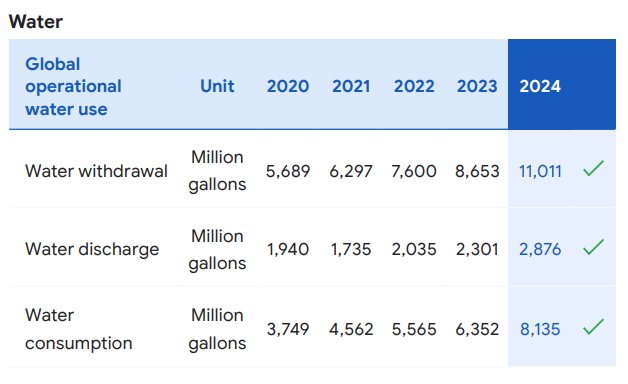
Figure 7: Google’s Yearly Global Water Use[99]
While 20% may seem to be a relatively small number, when considering the significant amount of water withdrawn by these facilities, the amount discharged is often quite substantial. The chart above is taken from Google's 2025 Environmental Report and shows that, of the 11 billion gallons of water Google withdrew for data centers in 2024, roughly 2.9 billion gallons was discharged to local wastewater treatment systems.[100] That same report provides water use metrics for the Google data center in Douglas County. According to the report, Google withdrew a little over 444 million gallons of water for that facility in 2024. Roughly 367 million gallons of that water was evaporated with 77 million gallons discharged to local wastewater treatment facilities.[101]
Not only do local wastewater treatment operators have to plan for the significant volume of water discharged from AI data centers, they also have to ensure that their systems can manage the specific chemical makeup of data center blowdown. Data centers chemically treat the water in their facilities to ensure that it meets strict water quality parameters. Managing water quality is a critical process for data center operations because poor water quality raises the risk of scaling, microbiological fouling, or corrosion[102] in the system. Facilities that experience any of those issues can be subject to extended downtime to clean or repair sensitive equipment. There is also the risk of the equipment failing completely, requiring expensive parts or replacing expensive equipment well before its anticipated failure date.
Cooling tower blowdown chemical mix
The water that is discharged from a data center includes some level of concentration of all of the chemicals that were used to treat it before it was discharged from the facility. In order to fully understand the burden AI data centers place on local wastewater treatment plants, we must first understand the chemical mix that is used within the facilities. This section will walk through the facility water treatment process to provide a holistic understanding of the various treatment processes used in these facilities and the types of chemicals used in these processes.
In order to ensure that cooling system water meets the stringent quality levels required to ensure the longevity of facility equipment, data centers operate a full water treatment system internally. The treatment process begins the moment water enters the facility from the municipal water system. The incoming water goes through an initial pre-treatment process as soon as it enters the facility and it is continually treated while it is in the facility to ensure that it consistently meets the following quality standards:
● Total dissolved solids (TDS): Target range of 500-1,500 mg/L for most cooling tower systems.
● Hardness: Calcium and magnesium concentrations should remain below 200-400 mg/L as CaCO₃ to minimize scale formation.
● Suspended solids: Cooling water specifications typically limit suspended solids to 10-25 mg/L.
● Biological content: While absolute sterility isn’t required, bacterial counts should remain below 10,000 CFU/mL through continuous disinfection.
● pH and alkalinity: Optimal pH ranges from 6.5-8.5 for most cooling systems with alkalinity between 50-200 mg/L as CaCO₃.[103]
The first step of the facility pre-treatment process is filtering. The water is passed through several physical filtration stages, followed by reverse osmosis, which removes debris and dissolved solids.[104] Then chemicals are introduced to control hardness and to reduce the risk of scaling.[105] The chemicals that are introduced during the pre-treatment phase are listed in the chart below.
Table 3: Pre-Treatment Cooling System Chemical Additives
|
Cooling
System Chemical Additives - Pre-treatment[106] |
|
|
Water quality
issue |
Chemical
treatment |
|
Hardness |
Calcium Oxide (lime) |
|
Scaling |
Sulfuric or hydrochloric acid
(lower pH) |
|
Low molecular weight acrylate
polymers |
|
|
Organophosphorus compounds
(phosphonates) |
|
|
Calcium carbonate |
|
Once the water moves into the cooling system, the key quality concern is contamination. Cooling towers recycle water internally through a process called Cycles of Concentration (CoC).[107] The water is used multiple times before it is flushed from the system as blowdown. As the water cycles through the system, it can be contaminated in a variety of ways. It can pick up debris from the pipes and machinery that it flows through. We call that debris deposits, and this particular type of deposit is called suspended solids. Facilities treat the insides of the cooling system pipes and equipment with natural and synthetic polymers to limit the amount of suspended solids that are picked up each cycle.[108] However, the solution isn't perfect. Sometimes these deposits cluster on system surfaces in a process that is called fouling. Fouling is treated chemically with dispersants,[109] but physical treatments like scrubbing or using water jets are used when the fouling reaches system-impacting levels.
Cooling systems include various pumps and machinery that can contaminate the water by leaking oil and grease. These kinds of contaminants are managed through the use of surfactants.[110] As with any body of water, there is a risk of organism growth in cooling system water. If untreated, microorganisms can form a biofilm on the surfaces of the system which could reduce the operational life of the system.[111] Operators manage microbial growth with a host of oxidizing antimicrobials, but the key treatment is chlorine.[112] Scale works in a similar way. Scale forms when calcium-based salts in the water build up and create a mineral film that coats system surfaces,[113] similar to how microorganisms form biofilm. Scaling is primarily managed with phosphonate scale inhibitors.[114] Water pH levels play a significant role in system scaling,[115] so facility operators use sodium hydroxide and sulfuric acid to manage pH levels.[116]
Finally, corrosion is a key concern for data center operators as it can shorten the life of all of the equipment that is touched by the cooling water. Corrosion is also the most complex issue to treat, requiring a multi-phase system approach that includes the controls for deposits, fouling, and microbial growth that we just discussed.[117] The chemical treatment for corrosion is corrosion inhibitors. There are a variety of commercially available corrosion inhibitors. Different metals deteriorate, or corrode, at different levels of chemical interaction. There are corrosion inhibitors that are specially designed for use with a particular type of metal (e.g. only copper or iron). Cooling systems include a variety of mechanical components that are made up of a diversity of metals. Data center operators typically use molybdate corrosion inhibitors for corrosion control because they are general purpose inhibitors that are suitable for use with the full range of metals that are utilized in modern cooling systems.[118] The chart below lists the various chemicals that are used to treat cooling water as it cycles through the cooling system.
Table 4: Operational Cooling System Chemical Additives
|
Cooling
System Chemical Additives - Operational[119] |
|
|
Water quality
issue |
Chemical
treatment |
|
Fouling/suspended solids |
Polymeric Dispersants (Lignosulfonate) |
|
Scaling |
Phosphonate Scale Inhibitors |
|
pH and alkalinity |
Sodium Hydroxide and Sulfuric
Acid |
|
Hydrocarbon leaks |
Surfactants |
|
Microorganisms |
Chlorine, Bromine, Isothiazolin |
|
Corrosion |
Molybdate Corrosion Inhibitors |
Cooling tower blowdown includes some level of all of the chemicals that were used during the pretreatment and operation phases. It also contains high concentrations of dissolved solids[120] and naturally occurring minerals. These contaminants are not naturally occurring in local water sources so the blowdown has to be treated before the water can be released into the local water system. But treatment is expensive. As a default, data center operators transfer that expense to the local utility by directly discharging cooling tower blowdown to municipal wastewater treatment facilities. However, there are three situations where the costs isn't automatically transferred and data center operators are required to pre-treat the blowdown before sending it to local wastewater treatment facilities:[121]
- The local government has enacted strict permitting limits that require pre-treatment for compliance.
- The local government has enacted enforceable water scarcity and reuse mandates.
- Local municipal infrastructure cannot handle the daily blowdown volume.
When one of those conditions exists, the local government can require facilities to pretreat the water to a certain level of quality on site, before they can discharge the water to municipal wastewater treatment systems. This is not an unknown or unreasonable requirement for facilities operators, there are a variety of well-established commercially available physical and chemical products sold to data center operators specifically for this purpose.[122] However, when a local government hasn't enacted permitting limits or enforceable reuse mandates, or when an AI data center receives an exception from them, the costs for treating AI data center blowdown is transferred to local wastewater treatment facilities.
Cooling tower blowdown volume
So how much discharge do the municipal facilities need to plan for? They need to plan for enough capacity to handle both annual and peak volumes.[123] Georgia has no laws or regulations that require data center operators to report the amount of water they are using to either state or local authorities. And there is no official state database that lists how many data centers are operating in Georgia. So, there is no direct way to determine peak or annual data center water use, evaporation, or discharge in the State of Georgia. But researchers are filling the gaps.
As of February 2025, researchers were able to verify 68 data centers operating in Georgia. The facilities were collectively using 6.5 gigawatts (GW) of power.[124] Researchers have estimated that Georgia's data center operators are withdrawing around 68.5 million gallons a day,[125] between 13 and 27 billion gallons of water per year,[126] to cool their facilities. Given that 20% of the water withdrawn by data centers is discharged to municipal wastewater treatment plants, local facilities in Georgia will be collectively required to manage 3 to 6 billion gallons of data center wastewater per year. And the number is growing.
As of February 2025, Atlanta had an additional 2 GW of data centers under construction.[127] If all of that capacity comes online, it would require an additional 9 billion gallons of water withdrawals, with 2 billion gallons discharged to wastewater treatment plants. This number only accounts for 2% of the region's water supply, but the water supply and data center demand isn't evenly distributed within the region. Some counties will bear significantly greater burdens than others. In addition to new construction, the amount of water required for each facility is also increasing. The Google data center in Douglas County illustrates this trend. The chart below lists the facility's water usage as reported by Google from 2022-2024.
Table 5: Yearly Data Center Water Usage - Google Data Center, Douglas County Georgia
|
Google's
Douglas County Facility Water Usage 2022-2024 (Million
gallons) |
||||
|
Year |
Water withdrawn |
Water evaporated |
Water discharged |
% Water
evaporated |
|
2022[128] |
378.3 |
305.2 |
73.1 |
81% |
|
2023[129] |
418.8 |
345.6 |
73.2 |
83% |
|
2024[130] |
444.1 |
366.9 |
77.2 |
83% |
The Douglas County facility's water withdrawals have increased by 15% over the 3 year period, and its discharge has increased by 6%. If Georgia's water supply and wastewater treatment capacity don't increase in line with the data centers that utilize them, there is a real risk of system failure.
Is Georgia's current and planned water infrastructure capacity sufficient to meet demand
Infrastructure is managed on long timelines, 10 to 30 year forecasts. The extensive planning processes involved are meant to protect these critical systems from capacity-related risks. Georgia has a strong long-term infrastructure planning process, which is why we were confident in our ability to obtain information about the state's current and planned water and wastewater capacity along with projected AI data center demand and perform an analysis to determine the scope and nature of any gaps. However, when we assessed the state's 2022 Industrial Water Use Assessment that was meant to anchor the demand portion of our analysis, we learned that data centers are not included as a category in the Assessment.[131] So we pivoted.
Georgia currently does not track data center water use at any governmental level, so there is no method for determining how much water data centers are withdrawing or discharging in the state.[132] Given that the majority of Georgia's AI data centers are located in the Metro Atlanta Region, and the need for a precise analysis to enable confident decision-making, we'll be focusing our gap analysis on the Metropolitan North Georgia Water Planning District ("the District"). As indicated in the map below, the District includes 15 counties and partially or fully covers 95 municipalities, including the entire Metro Atlanta Region.[133] While our assessment will broadly focus on the entire District, we also developed case studies based on data center activity in Douglas County and the City of Atlanta for more granular analysis.
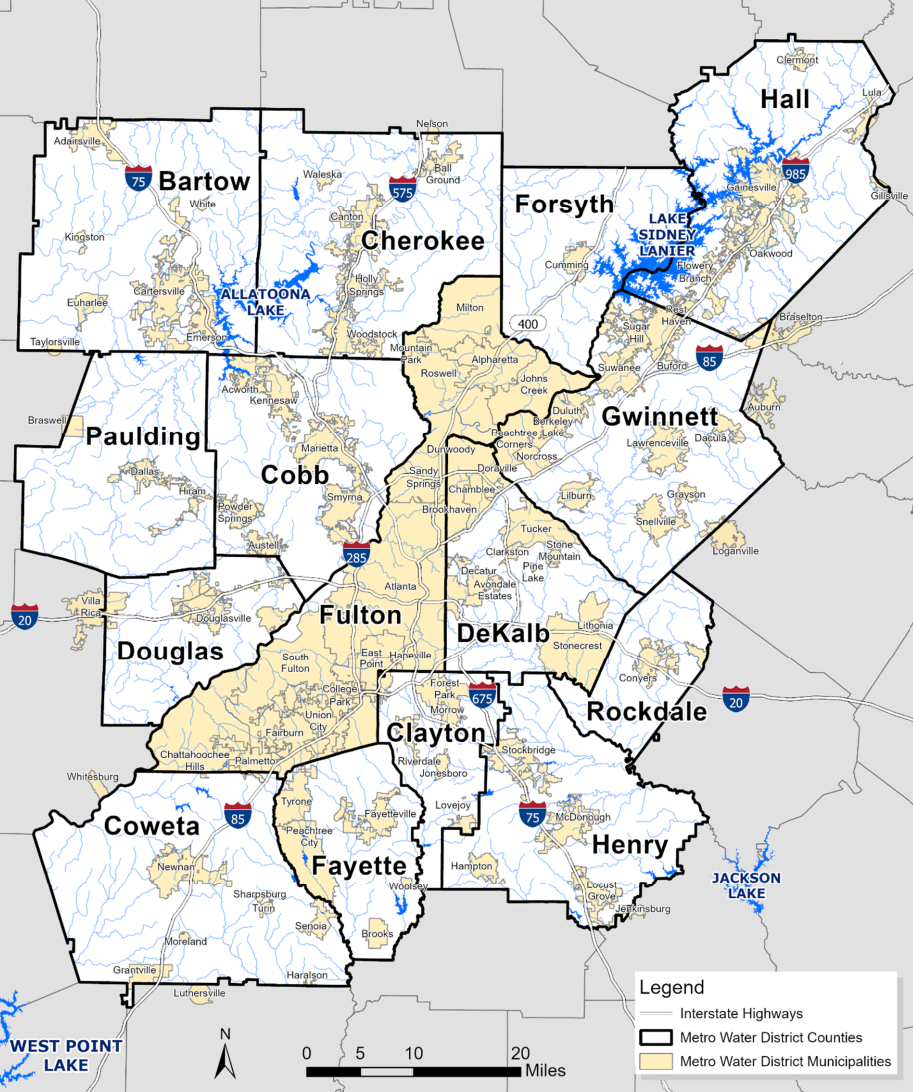
Figure 8: Map of Metropolitan North Georgia Water District[134]
District drinking water capacity
District drinking water capacity is measured in terms of annual average day flow (AADF), and the volume is reported in million gallons per day (MGD). Specifically, as of 2022, the District had issued permits allowing for AADF of nearly 989 MGD. This 989 MGD encompasses all of the water that was being withdrawn in the District for all uses (residential, industrial, agriculture, residential, etc.). The District set a maximum monthly withdrawal limit of 1,167.35 MGD, which provided a 20% buffer over the AADF for peak withdrawal months. For context, the District's 2022 drinking water permits allowed for nearly 60% higher withdrawals than 2019 (989 MGD v. 559 MGD).[135]
The District’s most recent Water Resource Management Plan was produced in December 2022. As part of that plan, the District forecast future water and wastewater demand based on the following sets of population projections:
- ARC Series 16 Population Projections, adopted in February 2020
- Georgia Governor’s Office of Planning and Budget (OPB) Series 2020 Population Projections, Medium Projections
- OPB Series 2020 Population Projections, High Projections[136]
As mentioned earlier, we don't have access to data on how much water data centers withdrew between 2019 and 2022. But we can use reported facility data to make some assumptions on the scale of their withdrawals. Google's Douglas County facility withdrew 444.1 million gallons of water in 2024, which is an average of 1.2 MGD.[137] Douglas County entire daily allotment of water is 24.5 MGD,[138] which means that one Google facility is utilizing an equivalent of 5% of the entire county's water supply. And it has been increasing its withdrawals every year for a total increase of 15% from 2022 to 2024. However, Douglas County is only planning to increase its drinking water capacity by 4% by 2040 (25.4 MGD in 2024 v. 24.5 MGD currently).[139] Douglas County, and counties all over Georgia are engaging in conservation efforts intended to decrease water supplies[140] during a time when data centers are rapidly increasing water demand. As AI data center withdrawals continue to increase, and the county's water capacity continues to decrease, the pressure on the local water system becomes more severe.
And, unlike people who return the water we use to the water system through the sink, shower, or toilet, Google's Douglas County facility evaporates over 80% of the water it withdraws. According to the EPA, Americans use an average of 82 gallons of water a day at home.[141] So, every day, Google's Douglas County facility withdrew enough water in 2024 to support nearly 15,000 residents that year. It then evaporated enough water to support nearly 12,000 residents in future years. That water is lost to the Douglas County community forever.
While it is instructive to consider the amount of water an AI data center withdraws annually, that number doesn't fully capture the level of pressure a data center puts on local water systems. Data centers don't run their evaporative cooling systems at a steady pace over the course of the year. Cooling system use is variable based on local temperature, humidity, and air quality conditions. According to a recent study, "data center water use is highly concentrated during the hottest days of the year, resulting in substantial peak daily water withdrawals."[142] Using Google's Douglas County facility as an example, on the coldest winter days the facility wouldn't use any water, while on the hottest summer days their peak water demand could have reached 8 MGD. Douglas County's current peak capacity is 24 MGD, which means this one facility could demand up to 33% of Douglas County's capacity on the hottest summer days.[143]
In recognition of the pressure the facility would put on local drinking water stores, Google designed the Douglas County facility to primarily utilize reclaimed water. As of 2024, 98% of the facility's water usage was from locally sourced reclaimed wastewater.[144] However, there are competing interests for the District's reclaimed water. Of the 13 water planning principles in the 2022 Water Resource Management Plan, 3 are related to reclaimed water use.[145] Reclaimed water is the District's key method for extending the life of water supplies. "With respect to non-potable reuse, this Plan generally sets a preference for return flows to local water supply sources where assimilative capacities are available."[146] While using reclaimed water for commercial purposes is allowed, "the District discourages these and other uses when they increase net water use."[147]
Given the hard limits on finite drinking water sources, data center developers are placing a premium on implementing water replenishment efforts.[148] The category of technologies used for water replenishment is called managed aquifer recharge (MAR), because they are ultimately designed to place water back into groundwater storage. Several states are using reclaimed wastewater for managed aquifer recharge, particularly California[149] and Virginia[150] which also host large numbers of data centers. The feasibility of MAR technologies is based on a variety of location-specific factors including: "source water characteristics, hydrogeologic factors, source water/aquifer interactions, engineering constraints, and economics."[151] But the key factor for water replenishment technologies is the availability of underground water storage capacity. MAR technologies augment groundwater with available surface water, allowing water management bodies to utilize both sources for sustainable water supply management.[152] The process is illustrated in the process flowchart below:
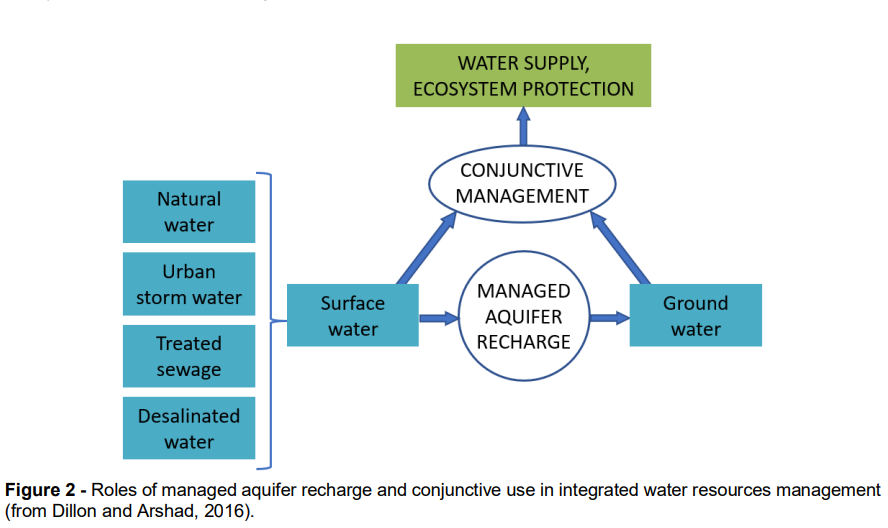
Figure 9: Managed Aquifer Recharge Process[153]
The process below indicates the critical role of surface water in the water supply management process. Surface water is used in two ways in this process. It is used in conjunction with groundwater as the locality's water supply source. It is also the source of the water that MAR systems pump into the ground to replenish groundwater.
The District's watershed is one of the smallest of any major metro region in the country, relying almost entirely on surface water from six small river systems.[154] Access to groundwater is severely constrained by the region’s granite bedrock.[155] With nearly no access to underground water storage, the entire Metro Atlanta region is reliant on the following six rivers for all of their water needs:
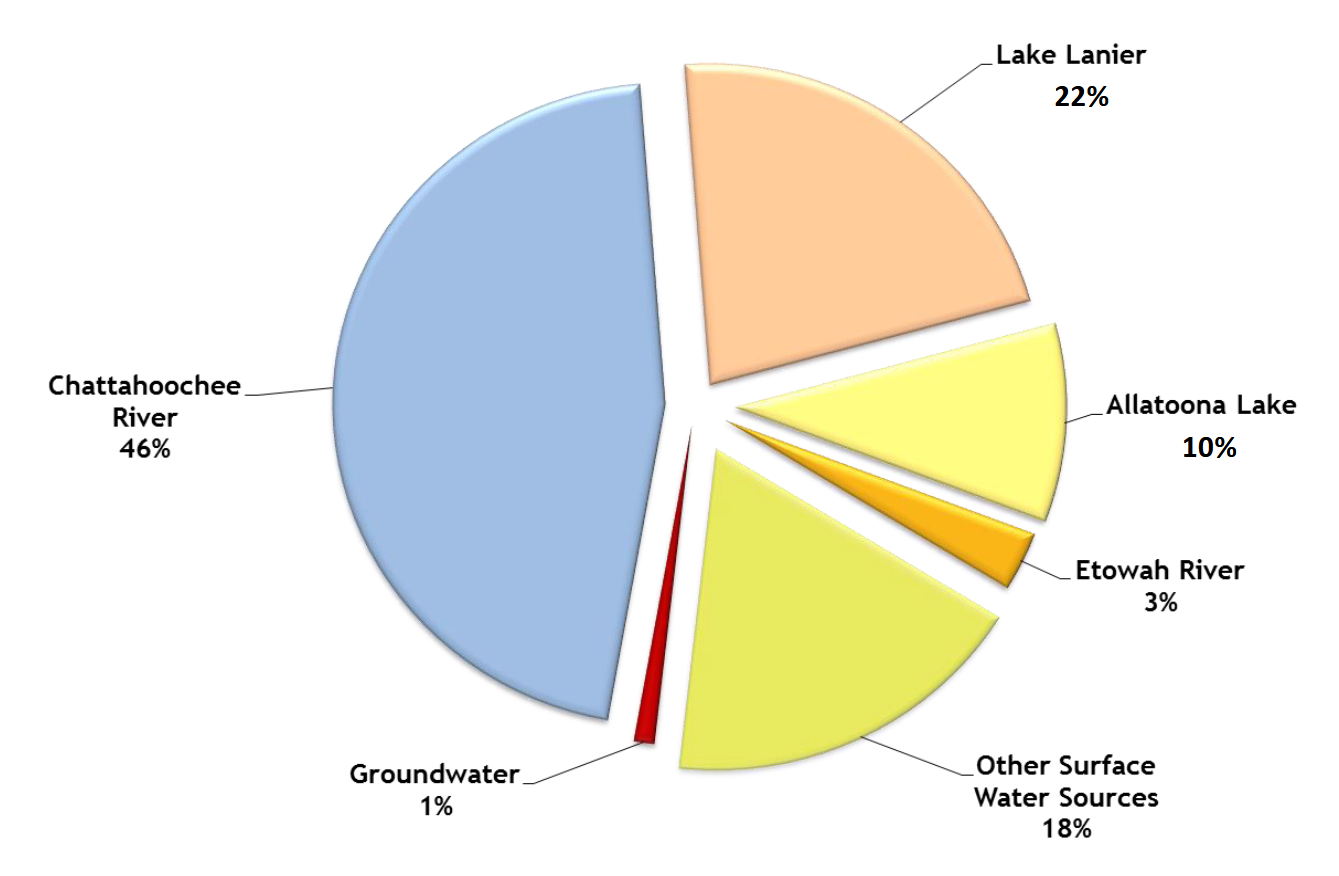
Figure 10: Water Sources - Metro Atlanta Region[156]
Unlike California and Virginia, the region that hosts the vast majority of Georgia's AI data centers does not have access to groundwater aquifers, which severely limits the usefulness of MAR technologies. As part of our interview process for this paper, we included questions about current or funded surface water replenishment projects in Georgia. We were unable to confirm any funded or currently operating projects in the state.[157]
District wastewater treatment capacity
The current concerns with wastewater treatment capacity mirror the issues with drinking water - capacity doesn't consider AI data center demand. The District currently has 83 publicly owned wastewater treatment facilities and 93 privately owned facilities. Wastewater treatment capacity is measured in terms of maximum month flow (MMF), and the volume is reported in million gallons per day (MGD). The District's publicly owned facilities have a total permitted capacity of 709 MGD,[158] while privately owned facilities add an additional 40.5 MGD of capacity. Unlike the drinking water analysis, a gap analysis of wastewater capacity also has to consider the type of treatment technology at each facility. Not all wastewater treatment facilities have the technology necessary to manage data center blowdown. The District's publicly owned facilities largely use advanced treatment technologies that "reduces biochemical oxygen demand to below 20 milligrams per liter (mg/L),"[159] while the vast majority of private facilities use conventional treatments. Specifically, private facilities use "chemical coagulation, flocculation, sedimentation, filtration and disinfection."[160]
To better understand how the volume of AI data center blowdown impacts local wastewater treatment facilities, we look to Google's Douglas County facility as an example. The facility discharged 77.2 million gallons of water in 2024, which is an average of 211,000 gallons discharged every day.[161] Douglas County has 12.8MGD of wastewater treatment capacity.[162] Which means this one facility will require a little less than 2% of the County's wastewater treatment capacity. While the annual average volume can easily be absorbed by wastewater treatment facilities, data center wastewater isn't discharged at a steady rate. The volume fluctuates dramatically based on the need for evaporative cooling.[163] Facility water withdrawal and discharge increases and decreases at the exact same rate because they are separate ends of the same process. When the water that comes in increases, the water that goes out also increases. On the coldest days of the winter Google's Douglas County facility wouldn't use any water, they won't discharge any wastewater. On the hottest days of the summer when the facility operates at peak evaporative cooling, the facility could use 8 MGD, and would discharge 1.2 MGD. On those peak days, this one facility would utilize 10% of the County's 12.8 MGD wastewater treatment capacity.
However, unlike with drinking water where counties are planning for less future capacity, counties are broadly planning for significant increases in wastewater treatment capacity. For example, Douglas County plans to increase capacity by 60% by 2040, from 12.8 MGD to 21.3 MGD.[164] The future capacity risk for wastewater treatment isn't a lack of planned capacity, it's clustering.
The fact that data centers are located in clusters exacerbates the strain on wastewater treatment facilities. The map below lists the data centers and wastewater treatment facilities located in Fulton County:
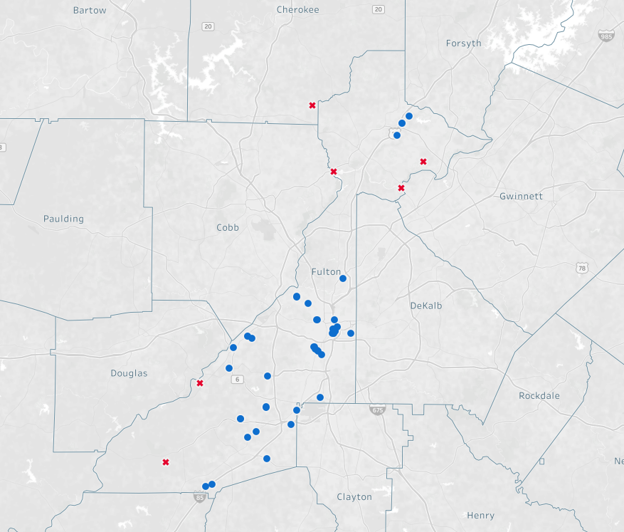
Figure 11: Map of Data Centers and Wastewater Treatment Plants in Fulton County Georgia[165]
As you can see from the image, there are significant numbers of data centers clustered around the county, with relatively few wastewater treatment facilities to serve them. While Fulton County has, by far, the most wastewater treatment capacity of any County in the district at 253.6 MGD,[166] managing peak discharge from clusters of large scale data center campuses would be challenging for even the largest wastewater treatment facilities.
In addition to volumetric capacity, wastewater treatment facilities need a certain level of technical capacity to manage data center blowdown. The Cooling System Chemical Additives charts in the beginning of this section list the variety of chemicals that are used in data center cooling systems and are present in high concentrations in cooling tower blowdown. Many of these chemicals are emerging contaminants that aren't currently monitored by the EPD.[167] Even wastewater treatment plants that utilize advanced treatment technologies may not be designed to fully or even partially remove these contaminants.[168] But a facility without access to advanced treatment technologies has no ability to manage data center blowdown. This limits the facilities that can accept data center blowdown to publicly owned wastewater treatment facilities, as they overwhelmingly utilize advanced treatment technologies.[169] However, there is currently no regional or state level guidance on the specific package of technologies that is required to properly treat AI data center blowdown. There also is no state or regional level reporting on facility-level water treatment technologies. So, there is no way to accurately determine how many wastewater treatment plants in the state have the necessary technological capabilities to manage AI data center blowdown.
Overall System Challenges
The data center boom is not happening in a vacuum. In addition to new challenges, the District is managing a collection of long-standing pre-existing challenges in its water and wastewater management systems. In its 2022 Water Resource Management Plan, the District provided a list of Continuing and Emerging Management Challenges.[170] The emergence of AI data centers has an exacerbating impact on many of the Challenges listed in the Table below. The following chart lists all of the Challenges that are impacted by AI data centers and provides high level suggestions for actions the District can take to begin to understand those impacts. Challenges that have been discussed in the body of the paper have been bolded and italicized.
Table 6: Data Center-Related Continuing and Emerging Management Challenges from the District's 2022 Water Resource Management Plan
|
Data
Center-Related Continuing and Emerging Management Challenges |
||
|
Continuing and
Emerging Management Challenge |
AI Data Center
Impact |
Potential Action
Items |
|
Consumptive
Use[171] |
AI data
centers consume ~80% of the water they withdraw even when using closed loop, zero
water internal cooling systems. |
Study
facility-level cooling innovations and provide recommendations on less
consumptive systems. |
|
Chemicals
of Concern[172] |
Data
centers introduce high volumes of chemicals of concerns into local wastewater
treatment systems. |
Implement
monitoring system for data center discharge and develop technology guidance
for wastewater treatment operators. |
|
Wastewater
Treatment Standards and Performance[173] |
Data
centers significantly increase wastewater treatment capacity needs as well as
introducing large volumes of highly concentrated nitrates. |
Perform
case studies on the impact of facility pre-treatment mandates on city
wastewater treatment performance. |
|
Limited
Assimilative Capacity[174] |
Data
centers significantly increase the volume of treated wastewater, which may
sharply reduce the assimilative capacity of targeted
surface waters. |
Assess
the capacity of local septic systems or land applications to address the
projected influx. |
|
Reclaimed
Water Reuse[175] |
Data
centers are increasingly utilizing reclaimed water to mitigate the impact on
drinking water stores. |
Assess
how the volume of reclaimed water used by data center can be balanced against
the need for returns to surface waters for other uses. |
|
Proximity
of Wastewater Discharges to Water Supply Intake[176] |
Data
centers withdraw significant surface waters for facility use and return
significant volumes of wastewater to those adjacent sources, potentially
upsetting the delicate balance between proximal uses. |
Perform
modeling of the impacts of high volume withdrawals and returns on closely
located intake and discharge systems. |
Community impact
When assessing the preparedness of Georgia's water infrastructure for AI data centers, it is important to consider how the system is currently functioning for Georgians. What are the areas of concern in the current state and how are AI data centers exacerbating the risks or harm? The following section will consider risks communities face as AI data centers increasingly strain local water and wastewater treatment systems.
Private well water quality and availability
While this paper has focused on the impacts of AI data centers on public water infrastructure, private wells near data center campuses are the first water systems to experience negative impacts. The first phase of a new data center build is to remove the ground and surface water from the land to prepare it for building. That process is called dewatering. There are several methods for dewatering a site,[177] but all of the methods produce the same result. They compact the land, drain any underground water storage, and cut off any naturally occurring water flows on the property. Private wells that rely on water flows that pass through the site are either fully interrupted or significantly clogged with sediments. Private well owners in Newton County were some of the first in the nation to raise this concern,[178] which has recently been echoed by residents in Morgan County.[179] Homeowners are spending thousands of dollars to replumb their homes after high sediment loads from their wells irreparably clogged the plumbing. The replumbing improves the water pressure, but it doesn't restore the water quality.[180]
Spills and service disruptions
The Metro Atlanta region has a long and fraught history of water outages. The brittleness of Metro Atlanta's drinking water infrastructure is well known. As indicated in the graphic below that was sourced from a 2014 report, nearly 15% of the District's drinking water was lost to "leaks and other issues of insufficient infrastructure."[181]
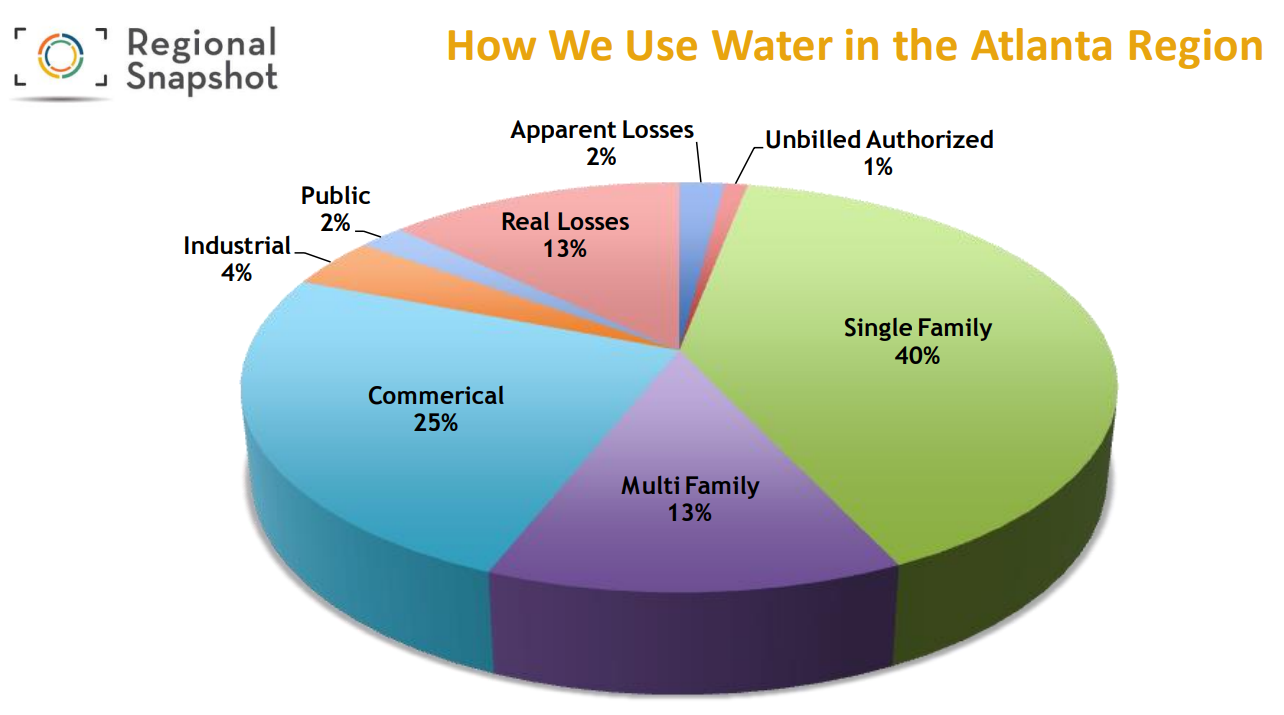
Figure 12: Atlanta Region Water Usage Chart (2014)[182]
While there have been many investments and improvements in Metro Atlanta's water system since that time, much of the existing infrastructure is around 80 years old.[183] Aging infrastructure and rapid growth have combined to weaken the system and it currently experiences "breaks almost every single day, if not several a day."[184] Adding highly inconsistent high volume flows to an already brittle system risks increasing outage frequency and severity.
While Atlanta's situation is extreme, outlying communities with newer water infrastructure are also feeling the pressure from the high volume AI data center demand. And while these systems may not break, service can be significantly impacted. The city of Fayetteville recently encountered a prolonged data center-driven water service impact. Residents suffered months of unusually low water pressure due to a data center's unpermitted withdrawal of 30 million gallons of water.[185]
While the brittle nature of Atlanta's drinking water infrastructure is generally well known, the state of its wastewater infrastructure receives much less public scrutiny. The city has been under a consent decree since 2012, and is required to report public wastewater system spills to Georgia's Environmental Protection Division and the US Environmental Protection Agency on a quarterly basis. The chart below lists the number and volume of spills from 2020 to 2024 (2025 is not included as the report is incomplete[186]).
Table 7: Yearly Summary of Public Wastewater Collection and Transmission Spills in the City of Atlanta
|
Atlanta
Wastewater Collection and Transmission Public Spills (Yearly Summary) |
||||||
|
|
Spill Type |
2020[187] |
2021[188] |
2022[189] |
2023[190] |
2024[191] |
|
Number of spills |
Major |
17 |
1 |
0 |
10 |
24 |
|
Non-major |
249 |
197 |
183 |
183 |
187 |
|
|
Total |
266 |
198 |
183 |
193 |
206 |
|
|
Spill location |
Spills to creek |
153 |
118 |
103 |
114 |
122 |
|
Overflows to dry land |
113 |
80 |
80 |
79 |
84 |
|
|
Spill volume (gallons) |
Major |
658,275 |
810 |
0 |
2,396,808 |
3,624,396 |
|
Non-major |
449,857 |
354,268 |
255,347 |
212,826 |
203,171 |
|
|
Total |
1,108,132 |
354,360 |
255,347 |
2,609,634 |
3,827,567 |
|
Atlanta has been able to keep the total number of spills significantly below 2020 levels. However, the frequency and severity of major spills started increasing sharply in 2023. Adding highly inconsistent high volume flows to an already brittle system risks increasing spill frequency and severity. And as we discuss below, failures in wastewater treatment systems can cause widespread negative health impacts.
Negative health outcomes
Data center blowdown is industrial waste. Chemicals are added to cooling system water the moment it enters the facility. The water picks up metal fragments as it runs through various pipes and mechanical systems. When water evaporates out of the cooling tower, it leaves all of those contaminants left behind in the remaining water. That water cycles through the system several times, picking up more contaminants each cycle, and becoming more concentrated with each evaporation cycle. When the water is too laden with contaminants to move through the system without causing equipment damage or loss of cooling efficiency, it is purged from the system. The resulting blowdown is a super concentrated mix of all of the chemicals and contaminants from the data center's industrial cooling process. Which is why it requires treatment before it can be released into municipal water systems. When that treatment breaks down or is ineffective, there are clear and significant impacts on community health.
Georgia's wastewater facilities may not have the technology necessary for filtering and treating the emerging chemicals that are present in AI data center blowdown. In the absence of those technologies, the chemicals would still be present in water that has been treated and released from the facility. There is also an emerging threat of the super-concentration of naturally occurring minerals overwhelming treatment plants. Morrow County, Oregon hosts seven massive Amazon-owned AI data centers.[192] While the county's wastewater treatment plants have been specifically designed to manage the chemicals present in AI data center blowdown, they weren't designed to handle the high concentrations of naturally occurring nitrates in the blowdown. This design oversight, coupled with a lack of storage space for the extremely high volumes of wastewater produced by the data centers, placed utility operators in the difficult position of having to dump the wastewater onto nearby farmlands, with state approval. The toxic levels of nitrates released into the local water system are being linked to miscarriages and cancer amongst the local population.[193] For context, Google owns a single AI data center in the Dalles, two counties over, that discharged 259 million gallons of blowdown to local wastewater treatment facilities between 2022 and 2024.[194]
Generations of fertilizer runoff from farming and lawn care have cemented nitrates as a natural part of the water profile for all of Georgia's rivers. The Chattahoochee River, which supports the Metro Atlanta region, also has low levels of arsenic that are generally controlled by microbial activity in the water.[195] If either of these naturally occurring contaminants were to enter the drinking water system in highly concentrated amounts, there would be significant public health impacts. In order to ensure the efficacy of blowdown treatment, wastewater treatment operators need to identify problematic naturally occurring substances in Georgia's river waters and design treatment systems that address highly concentrated levels of those substances.
While appropriate wastewater treatment system design is critical for protecting community health, system failure is a key concern. As indicated in the Atlanta Wastewater Collection and Transmission Public Spills chart, Atlanta's wastewater treatment systems fail often. And when they fail, they often fail into the creeks that feed Georgia's rivers. System failures that release blowdown chemicals into the local water system could prove disastrous, even fatal to the people, wildlife, and ecosystems downstream of the release. The chart below details the toxicity of the chemicals used to treat data center cooling water. These chemicals appear in high concentrations in AI data center blowdown.
Table 8: Blowdown Chemical Toxicity Chart
|
Blowdown Chemical Toxicity
Chart |
||
|
Chemical |
Toxicity |
Regulatory Requirements |
|
Calcium Oxide[196] |
Harmful if inhaled |
Regulated by OSHA; cited by ACGIH, DOT, NIOSH,
and NGPA |
|
Sulfuric Acid[197] |
Harmful if touched or inhaled, fatal if
ingested |
Listed on the EPA's National Priorities List |
|
Hydrochloric Acid[198] |
Harmful if touched or ingested, fatal if
inhaled |
NIOSH categorized Immediately Dangerous to Life
or Health at >50 ppm exposure |
|
Ethyl Acrylate[199] |
Harmful if touched or ingested, fatal if
inhaled |
Not regulated |
|
Phosphonates[200] |
Not considered toxic (further study
recommended) |
Not regulated |
|
Calcium Carbonate[201] |
Harmful if touched, fatal if inhaled or
ingested |
Regulated by OSHA, NIOSH, and EPA |
|
Lignosulfonate[202]
|
Not considered toxic |
Not regulated |
|
Phosphonate Scale Inhibitors[203] |
Non-toxic |
Not regulated |
|
Sodium Hydroxide[204] |
Harmful if inhaled, extremely harmful if
touched or ingested |
NIOSH categorized Immediately Dangerous to Life
or Health at 10 mg/m3
exposure |
|
Surfactants[205] |
Harmful if touched or ingested |
Not regulated |
|
Chlorine[206] |
Harmful if touched, ingested, or inhaled |
NIOSH categorized Immediately Dangerous to Life
or Health at 10 ppm
exposure |
|
Bromine[207] |
Harmful if touched, ingested, or inhaled |
Regulated by the EPA[208] |
|
Isothiazolin[209] |
Harmful if touched, ingested, or inhaled |
Regulated by the EPA[210] |
|
Molybdenum[211] |
Harmful if inhaled (further study recommended) |
Not regulated |
Creating this chart was a difficult and time consuming task. There is no single federal or state portal or list for hazardous chemicals. And some of the chemicals have not been fully evaluated by state or national agencies. We had to refer to research papers to get an understanding of the toxicity of surfactants, isothiazolin, and phosphonate scale inhibitors and had to look to industry materials to understand ethyl acrylate. Information about these chemicals should be more accessible and understandable for the public and wastewater treatment operators. A wastewater system failure that released these chemicals into the river system would not only impact the 5.2 million Georgians living in the Metro Atlanta region, it would impact all Georgians who depend on the affected rivers for drinking water, along with their livestock and any neighboring wildlife.
Rate increases
In the US, utility maintenance and upgrades are generally funded by ratepayers. Georgia is no different, residential and industrial ratepayers fund water and sewer services.[212] When upgrades are needed, they are funded through rate increases. Water utility rates are set at the county level, and while many counties in the region opt for yearly 5% increases to cover costs, Dekalb County has locked in a 10% yearly increase through 2035. These rate increases will significantly impact affordability over time, particularly for residents of Dekalb County, as illustrated in the chart below.[213]
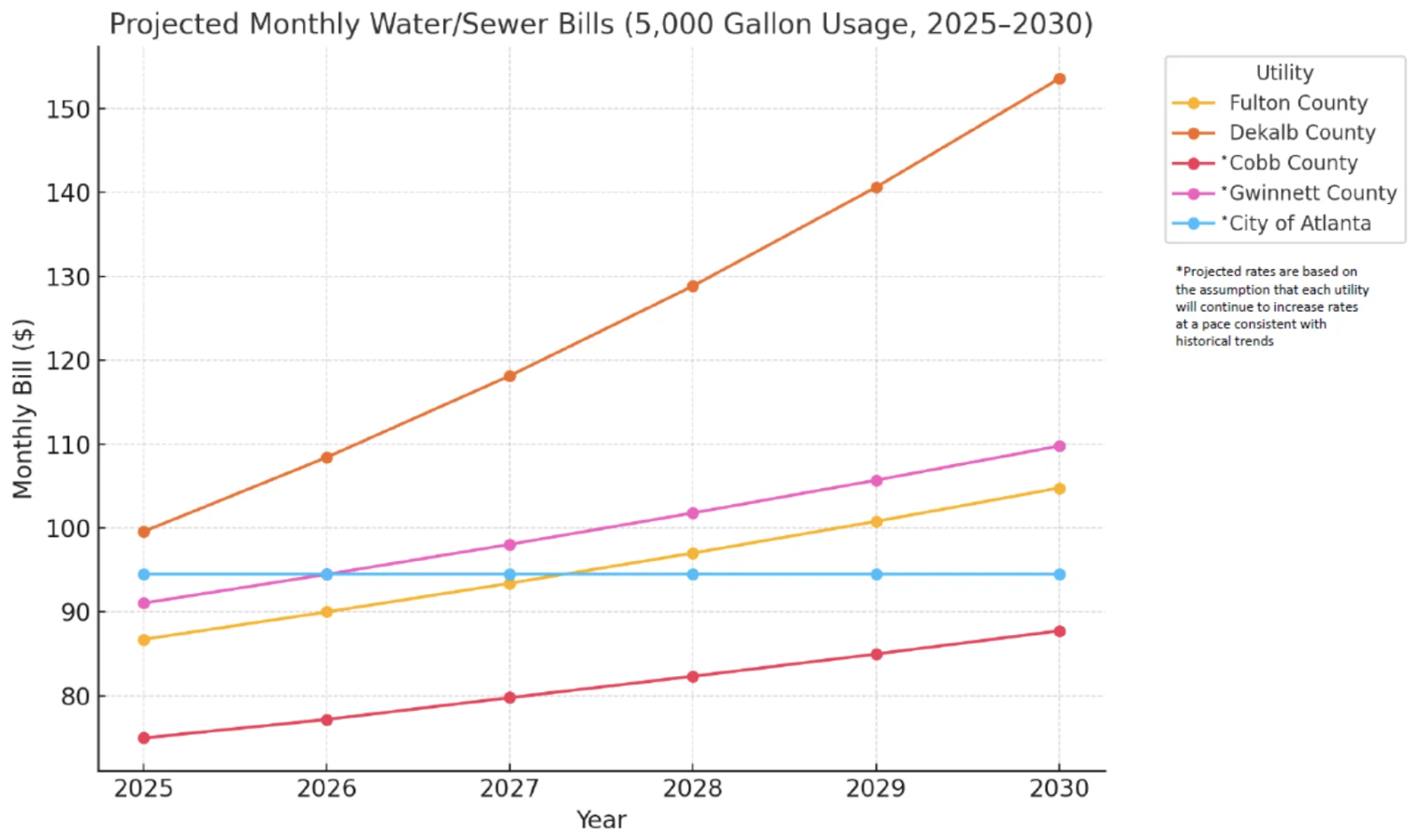
Figure 13: Atlanta Counties Projected Monthly Utility Bills (2025-2030)[214]
However, these increases were approved without consideration for the type and scale of improvements that will be required to support the ever-increasing number of AI data centers in these counties. Supporting AI data centers requires utilities to increase drinking water pipeline capacity and wastewater treatment capacity, along with upgrading wastewater treatment technologies to manage emerging contaminants. Since counties don't have access to information on the scale of annual and peak data center water demand, these costs have not been fully assessed. Any costs that increase utility improvement budgets by more than 5% or 10% a year would be borne by current customers in the form of additional rate increases.
There also hasn't been any analysis done on the impact of AI data centers on Atlanta's reserve water supply. In 2015, the City of Atlanta undertook a five year, $321 million dollar project to expand the city's raw water reserve from a three-day supply to a 30+ day supply.[215] All across the country AI data centers are considered to be critical infrastructure. Critical infrastructure continues to operate during drought conditions. If Atlanta, the District, or Georgia deem AI data centers to be critical infrastructure, then they might have the ability to withdraw water from Atlanta's recently bolstered reserve supply to continue to operate in times of drought. We asked our interviewees who determines if an industry or facility is deemed critical infrastructure, they didn't know.[216] In order to understand whether Atlanta's AI data centers would ever be able to access the reserve water supply, government officials would first need to determine whether AI data centers are critical infrastructure and then examine the laws to determine what rights that designation grants them. If there are any circumstances in which one or multiple AI data centers can access Atlanta's reserve water supply, then the system may need to be bolstered. Taxpayers would likely bear at least a portion of the costs.
Who is managing these new risks
Georgia, specifically the Metro Atlanta region, has been the fastest growing data center market in the world since 2023.[217] AI data center construction grew 75% between 2024 and 2025. And the market is continuing to grow and expand across the state. The image below shows planned data centers as black and orange circles and currently operating facilities as black and white circles. According to this image, the full-scale Georgia data center build out is just getting started.
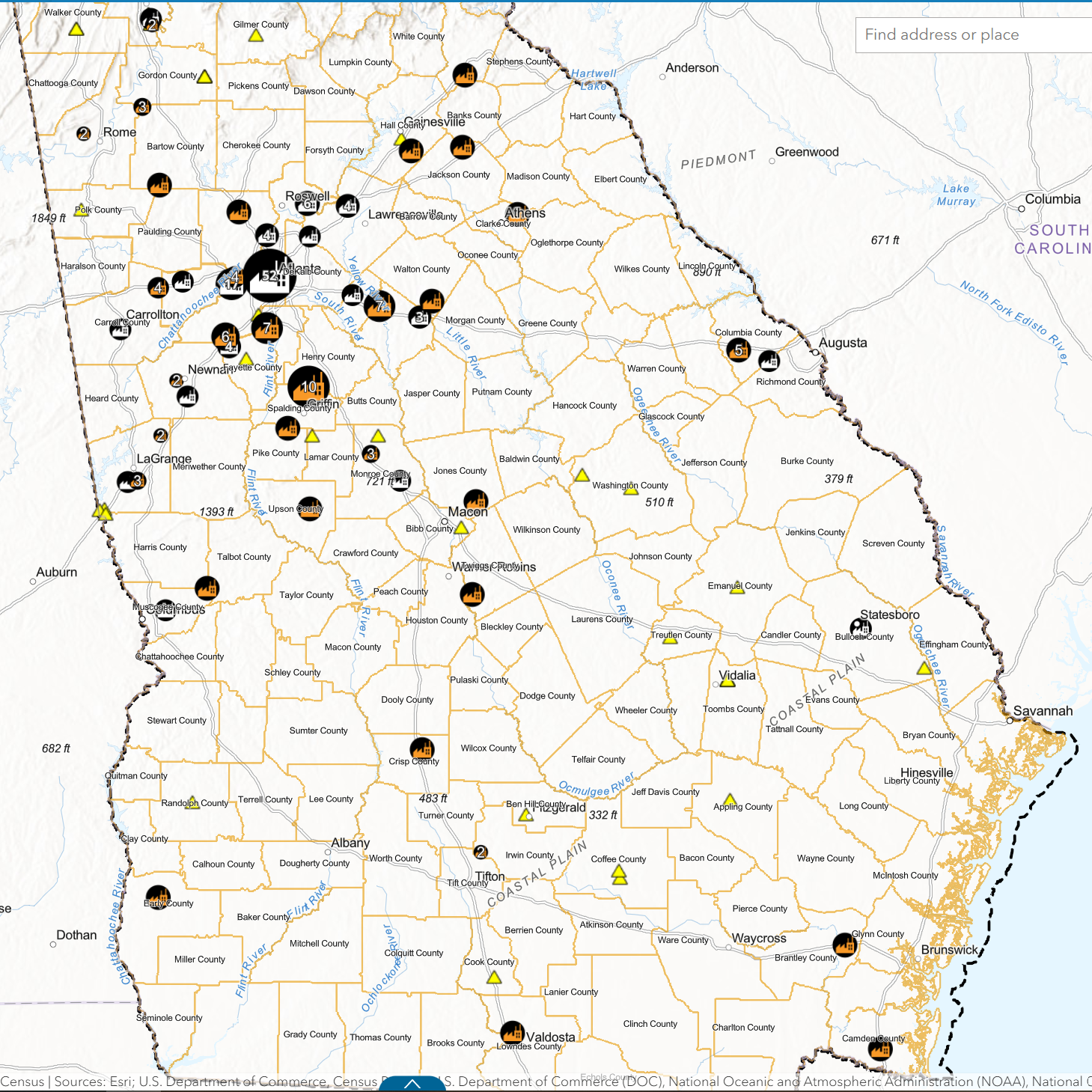
Figure 14: Map of Current and Planned Georgia Data Centers[218]
While the initial development focus was on Atlanta, new AI data center clusters are being proposed all across the state. Many of the proposed facilities are located in small cities and counties with much smaller local governments than Atlanta or Augusta. For example, five data centers are being proposed in Troup County, whose entire population is a little over 69,000.[219] As these facilities spread across the state, there is a real need for leadership in managing the significant water impacts that we've discussed in this paper. In order to understand what that leadership would look like, we mapped out Georgia's current water and wastewater management organizational structure.
Water and Wastewater Management Organizational Structure
Georgia has a robust structure of state, regional, and local water and wastewater management. At the state level, the Georgia Department of Natural Resources (DNR), is the primary agency responsible for managing Georgia's natural resources, including its water resources.[220] The Environmental Protection Division (EPD), is the division of the DNR that is tasked with administering all of the state's major water permits.[221] Within the EPD, the Watershed Protection Branch (WPB), is responsible for wastewater, drinking water, water withdrawals, agricultural water withdrawals, stormwater, erosion, and sedimentation. The DNR utilizes this multi-tiered structure to manage all aspects of Georgia's water. However, financing is handled by a different state entity. The Georgia Environmental Finance Authority (GEFA), manages infrastructure financing in the state.[222] GEFA provides low-interest loans and administers federal grants for public water, wastewater, and solid waste infrastructure, along with administering the Clean Water State Revolving Fund (CWSRF) and Drinking Water State Revolving Fund (DWSRF) loan programs.
The regional level water management structure is dictated by Georgia's first State Water Plan. In 2004, Georgia passed the Comprehensive State-wide Water Management Planning Act that mandated the development of a state-wide water plan.[223] The first State Water Plan[224] mandated the creation of Regional Water Planning Councils that were tasked with developing and updating Regional Water Development and Conservation Plans.[225] Those regional water plans form the basis of the State Water Plan. Regional Water Planning Council members are appointed by the Governor, the Lieutenant Governor, or the Speaker of the House.[226] The Georgia Water Council is composed of members of the various Regional Water Planning Councils, and is responsible for coordinating water planning amongst water planning regions.[227] The Georgia Water Council provides input to EPD on the development and revision of the State Water Plan, and it approves the State water Plan.
As indicated in the image below, each Regional Water Planning Council is responsible for several counties and cities.
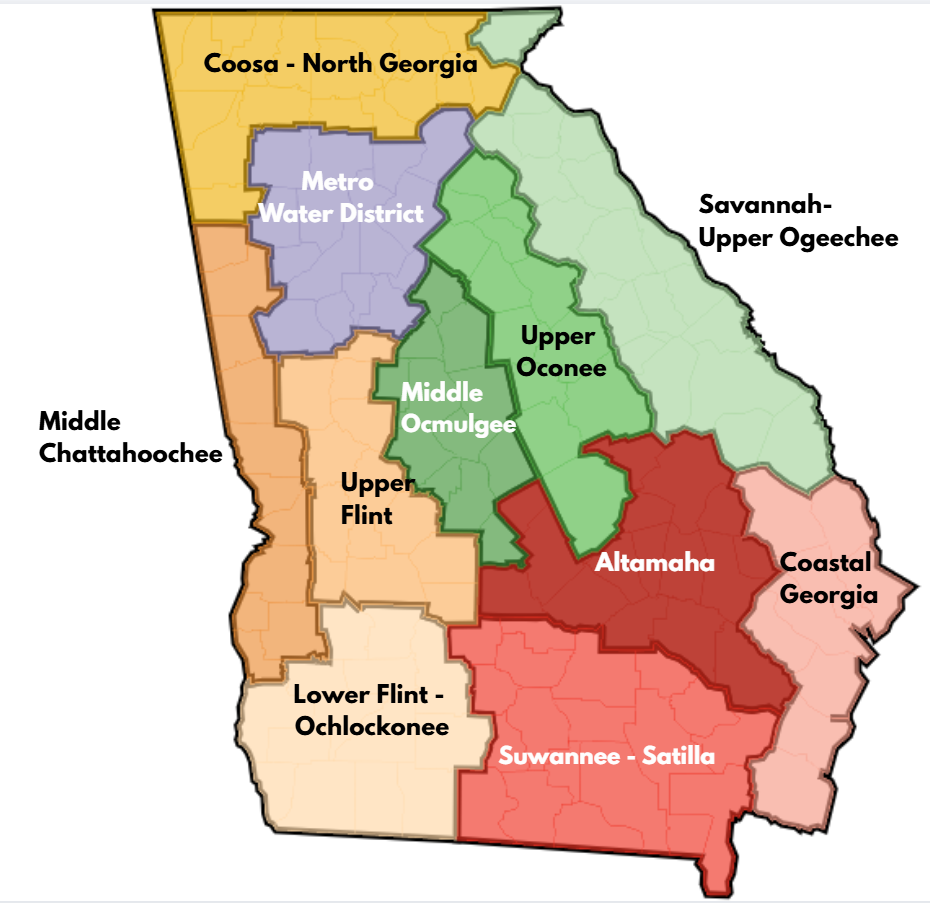
Figure 15: Map of Georgia’s Water Planning Regions[228]
At the local level, local governments provide
the demand and use metrics for the Regional Water Development and Conservation
Plans. They produce those metrics through a locally managed Strategic Master
Plan process.[229] The
following table lists the various entities that are responsible for water and
wastewater management in Georgia, along with their areas of responsibility.
Table 9: Georgia Water and Wastewater Management Entities
|
Georgia Water and
Wastewater Management Entities |
|
|||
|
Level of
Government |
Entity |
Relevant Areas of
Responsibility |
|
|
|
State |
Department of Natural Resources |
Develop state rules and regulations,
provide policy direction |
|
|
|
|
Environmental Protection Division |
Major water permits, drought
declarations, public notices, draft and enforce State Water Plan |
||
|
Watershed Protection Branch |
Watershed permits, water quality
standards, monitoring programs, compliance actions |
|||
|
Georgia Environmental Finance
Authority |
Manage low-interest loan program,
administer federal grants and State Revolving Fund loan programs |
|
||
|
Regional |
Georgia Water Council |
Coordinate water planning amongst
water planning regions, provide input to EPD on the development and revision
of the State Water Plan, approve State Water Plan |
|
|
|
Regional Water Planning Councils |
Develop and update Regional Water
Development and Conservation Plans (~5 year cycle) |
|
||
|
Local |
County Water/Wastewater Management |
Develop and update Strategic Master
Plan (~10 year cycle), provide inputs for Regional Water Development and
Conservation Plans |
|
|
|
City Water/Wastewater Management |
Manage local water withdrawals
comply with the EPD withdrawal permit |
|
||
How the management bodies intersect
Georgia's water and wastewater management organizations have intersecting responsibilities across all areas of management. The graphic below displays how state, regional, and local organizations overlap in the following areas: water planning, watershed protection, wastewater management, permitting and monitoring, and financing and funding. For example, water planning is primarily managed by the Georgia Water Council and Regional Water Planning Councils. However, their water planning activities intersect with watershed protection, which is a shared responsibility between WPB and the Regional Water Planning Councils, as the state water plan guides watershed management. The Councils' water planning activities also intersect with permitting and monitoring, which is a shared responsibility between the EPD and WPB, as the EPD cross-checks the permits and technical limitations (e.g. Total Maximum Daily Load), for its enforcement activities with relevant regional water plans.
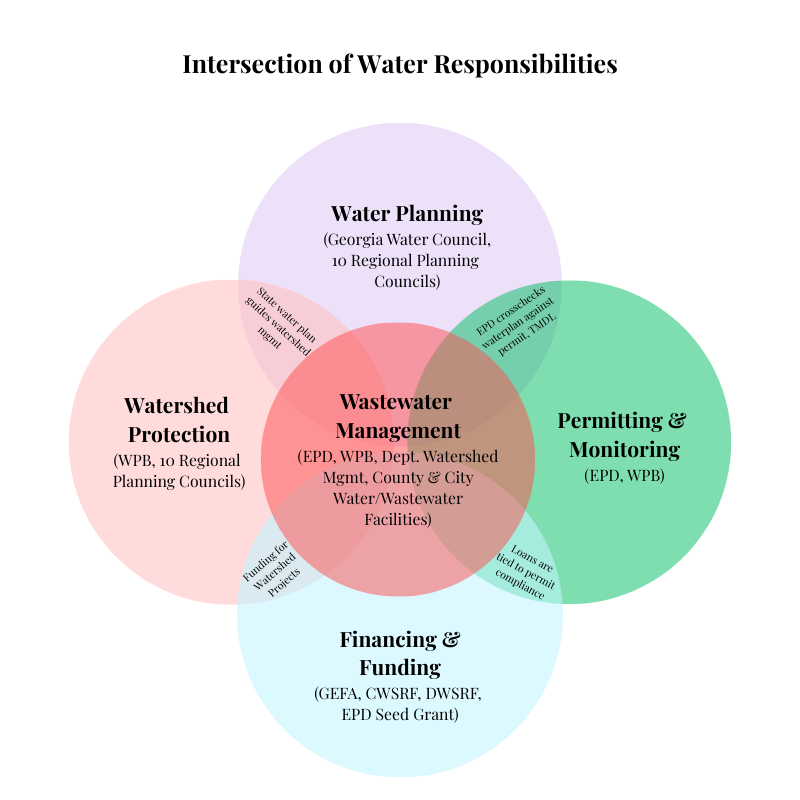
Figure 16: Georgia Water and Wastewater Management Entities Responsibility Venn Diagram[230]
Metropolitan North Georgia Water Planning District provided the following explanation of how these intersections work in practice:
"The District develops the Plan. It is implemented by local jurisdictions, which are required to comply with it. Georgia EPD enforces the Plan’s provisions through an auditing and permitting process. For example, local jurisdictions must demonstrate compliance with the Plan in order to obtain permits for new or expanded water withdrawals or wastewater discharges and renewal of National Pollutant Discharge Elimination System (NPDES) Municipal Separate Storm Sewer System (MS4) permits. Furthermore, consistency with Plan requirements is necessary to obtain Georgia Environmental Finance Authority (GEFA) grant or loan funding for water projects."[231]
The intersections between water and wastewater management authorities in Georgia are robust, but structural collaboration is minimal. The Georgia Water Council is a collaborative body, but it is comprised of members from the same organizational area. In our interviews with water and wastewater management professionals we asked whether they were involved or aware of any inter-agency committees or working groups dedicated to discussing data centers in the state, none of the respondents were involved in or knew of any inter-agency collaborations.[232]
The stress AI data centers place on water and wastewater capacity and infrastructure is not unique to the Metropolitan North Georgia Water Planning District. These issues are present in any city, county, or region that hosts AI data centers, and may be felt more acutely in small communities where local governments are understaffed and suffer high turnover rates.[233]
While the State Water Plan is administered from the top down, it is developed from the bottom up. Local governments are tasked with assessing their water masterplan needs and providing that information to regional planning districts so that it can be incorporated into the Regional Water Plan, which is then incorporated into the State Water Plan.[234] Leaving small, understaffed community governments to perform highly technical data center water assessments, without regional or state aid or direction, will lead to significant variations in assessment type, robustness, and quality. There is no state, regional, or local water or wastewater management organization that is specifically tasked with ensuring that the full scope of AI data centers impacts is incorporated into water planning, watershed protection, wastewater management, and permitting and monitoring activities. Collaboration across all levels of water management is necessary to ensure the development of a robust, broadly applicable gap analysis framework that would enable all of Georgia's local governments to fully assess their gaps and provide accurate information to Regional Water Planning Councils.
Findings
Our most pressing finding is that AI data centers have not been explicitly considered at any level of Georgia's water management organizational structure. The risk of long-term capacity and technological underestimations is significant, particularly in cities with brittle infrastructure and cities and counties with understaffed local governments that struggle to perform accurate demand analysis. The speed and scale of Georgia's AI build out will have significant impacts on water systems all across the state. In order to ensure the continued safe and reliable operation of water and wastewater treatment systems, Georgia should incorporate data centers into the state-level water planning process. The currently ongoing regional planning process should be amended to require a data center study as an addendum, similar to the effort undertaken by the Interstate Commission on the Potomac River Basin.[235]
The lack of data on data center operations is a barrier to effectively incorporating them into the State Water Plan. Reporting rules need to be updated at the state and regional level to require facility level data center water use. This information is necessary for local level water management to accurately populate their Strategic Master Plans, which will enable them to provide accurate information to Regional Water Planning Councils. Regional bodies should implement facility wastewater monitoring to gather data about the types and concentrations of contaminants that are present in data center blowdown. This will allow local governments to better assess the need for facility-level pre-treatment requirements and allow wastewater treatment operators the ability to determine the types of filtration they need to invest in to effectively treat facility blowdown.
The issues raised in this study cannot be addressed by a single agency, or a single level of water management. These are complex subjects that impact communities across the state to different degrees. Managing these risks will require a collaborative effort across all layers of water management. Georgia should create a cross-functional task force to study the impact of AI data centers on the state's water systems and provide guidance and recommendations for addressing gaps and mitigating negative impacts. The mandate for the task force should be broad, from evaluating the suitability of current water demand indicators, to providing local level guidance on incorporating data centers into water master plans or treating data center blowdown, to studying the feasibility of surface water replenishment technologies.
Conclusion
Water is a finite resource and every community’s allotment must be shared across all industrial, commercial, agricultural, and residential uses. Metro Atlanta’s reliance on a small number of surface water sources makes the balancing act between competing uses much more precarious than it is in nearly any other major US city. The speed and aggressiveness of Georgia’s AI data center build out is poised to tip that balance firmly towards a handful of AI data center customers, to the detriment of all other users.
Restoring balance will not be achieved through technical innovation alone. Water planning agencies across all areas of water-related infrastructure will need to explicitly consider the needs of AI data centers in their planning processes. For wastewater treatment infrastructure, capacity planning must consider filtration and treatment technologies along with discharge volume. Successful states will engage in a cross-agency effort to revamp planning processes, develop data transparency requirements, set rules requiring the use of proven water saving or reuse technologies, implement monitoring systems, and create processes to assist under-resourced communities with their educational, planning and enforcement needs.
The findings in this report may be specific to Georgia, but they are not unique to Georgia. These issues persist in communities across the US and the world, many of whom are actively engaging data center developers to build facilities in their communities. It is our hope that cities, states, and countries across the globe will use this report as a framework for identifying gaps in their AI data center readiness and implement the findings that are most applicable to their locality.
[1] Corresponding authors:
Masheika Allgood (founder@allai-us.com) and Brandeis Marshall
(hello@dataedx.com)
[3] Dawn-Hiscox,
Tanwen. T5 is building a $100m data center in the Atlanta metro area.
Data Center Dynamics. (February 7, 2018)
[4] Dawn-Hiscox,
Tanwen. CBRE: Record-breaking six months for the US data center market.
Data Center Dynamics. (October 2, 2017)
[5] Dawn-Hiscox,
Tanwen. Microsoft Azure acquires land worth $28m for Atlanta data center.
Data Center Dynamics. (December 9, 2020)
[6] Alley,
Alex. CBRE: US data center market to grow by 13.8% in 2021. Data Center
Dynamics. (November 17, 2020)
[8] Metropolitan
North Georgia Water Planning District. North Georgia Data Centers and Water
Resources in Metro Atlanta.
[10] Moss. Sebastian. Anthropic to use all of SpaceX-xAI's
Colossus 1 data center compute. Data Center Dynamics. (May 6, 2026)
[11] Mackereth, Oscar. Accounting for AI: Financial Accounting
Issues and Capital Deployment in the Hyperscaler
Landscape. Cerno
Capital. (October 4, 2025)
[12] Vellante, Dave. Resetting GPU depreciation: Why AI
factories bend, but don’t break, useful life assumptions. Silicon Angle. (November 22, 2025)
[13] Vellante, Dave. Resetting GPU depreciation: Why AI
factories bend, but don’t break, useful life assumptions. Silicon Angle.
(November 22, 2025)
[14] Shilov, Anton. Datacenter GPU service life can be
surprisingly short — only one to three years is expected according to unnamed
Google architect. Tom's Hardware. (October 24, 2024)
[15] Devasia, Anish. Data Center Operating Costs: Complete
Guide (2026). The Network Installers. (December 29,
2025)
[16] [Modified from] Higgins,
Andrew. A Guide to Responsible Water Use in Data Centers. Equinix.
(March 19, 2026)
[17] Allgood, Masheika. The fallacy of closed loop cooling
systems. Eat Your Frog. (February 5, 2025)
[20] Elliott, Pete. Balancing energy and water in
direct-to-chip cooling system design for data centres. (October 21, 2025)
[22] Carriero, Chris. Data Center Liquid Cooling vs Air
Cooling – Which is Best? Park Place Technologies. (May 14, 2025)
[23] Strong, Lars. Data Center Cooling Effectiveness Versus
Efficiency. Upsite
Technologies. (April 23, 2025)
[24] How Data Center Liquid Cooling is
Reshaping Infrastructure Design. Apex Piping. (October 1, 2025)
[25] Coolnet. Chilled Water Rear Door Heat Exchanger for Data
Center Cooling. (Accessed June 10, 2026)
[26] Vertiv
Insights. Understanding direct-to-chip cooling in HPC infrastructure: A deep
dive into liquid cooling. (August 21, 2024)
[27] Kevin,
DR. Cold Plate Liquid Cooling vs Immersion Liquid Cooling: Understanding the
Differences and Selection Guidelines of Core Technologies in One Article. ToneCooling. (November 11, 2025)
[28] Taki, Andre. AI GPU Cooling Revolution: Deionized
Water, Ethylene Glycol & Propylene Glycol – The Ultimate Liquid Cooling
Guide. Alliance Chemical. (updated April 5,
2026)
[29] Taki, Andre. AI GPU Cooling Revolution: Deionized
Water, Ethylene Glycol & Propylene Glycol – The Ultimate Liquid Cooling
Guide. Alliance Chemical. (updated April 5,
2026)
[31] Yañez-Barnuevo,
Miguel. Data Centers and Water Consumption. Environmental and Energy Study
Institute. (June 25, 2025)
[32] Bunger, Robert et. al. Comparison of Dielectric Fluids for
Immersive Liquid Cooling of IT Equipment. Schneider Electric. (November 24,
2020)
[36] Ontiveros, Jeremie Eliahou, et al. Datacenter Anatomy Part 2 – Cooling
Systems. SemiAnalysis.
(February 13, 2025)
[37] Ontiveros, Jeremie Eliahou, et al. Datacenter Anatomy Part 2 – Cooling
Systems. SemiAnalysis.
(February 13, 2025)
[38] Ontiveros, Jeremie Eliahou, et al. Datacenter Anatomy Part 2 – Cooling
Systems. SemiAnalysis.
(February 13, 2025)
[39] Meyer, Adam. Adiabatic Cooling Keeps Pace with
Growing Data Center Heat Density. Chiller & Cooling Best Practices.
(April 19, 2017)
[41] Meyer, Adam. Adiabatic Cooling Keeps Pace with
Growing Data Center Heat Density. Chiller & Cooling Best Practices.
(April 19, 2017)
[42] Meyer, Adam. Adiabatic Cooling Keeps Pace with
Growing Data Center Heat Density. Chiller & Cooling Best Practices.
(April 19, 2017)
[43] Saini, Satyam et. al. Effects of Gaseous and Particulate
Contaminants On Information Technology Equipment Reliability - A Review. Journal of Electronic Packaging. (May
2021)
[46] Hamilton, Drew. Pros and Cons of Different Economizer
Configurations for Data Centers. Hallam ICS. (June 1, 2023)
[47] Hamilton, Drew. Pros and Cons of Different Economizer
Configurations for Data Centers. Hallam ICS. (June 1, 2023)
[48] Shehabi, Arman, et al. Energy Implications of Economizer Use in
California Data Centers. Lawrence Berkeley National Laboratory.
(2008)
[49] Hamilton, Drew. Pros and Cons of Different Economizer
Configurations for Data Centers. Hallam ICS. (June 1, 2023)
[50] Hamilton, Drew. Pros and Cons of Different Economizer
Configurations for Data Centers. Hallam ICS. (June 1, 2023)
[52] Ontiveros, Jeremie Eliahou, et al. Datacenter Anatomy Part 2 – Cooling
Systems. SemiAnalysis.
(February 13, 2025)
[54] Rojanasakul, Mira, et. al. America Is Draining Its Groundwater Like
There's No Tomorrow. New York Times. (December 29, 2023)
[55] Metropolitan North Georgia Water
Planning District. Data Centers and Water Resources in
Metro Atlanta. (Accessed June 10, 2026)
[56] Genesis
Water Tech. Wastewater
Reuse for Data Center Cooling: A Practical Guide.
Genesis Water Technology. (October 30, 2025)
[57] EAI Water. Water Treatment Trends for Safe Reclaimed Water Use in
Data Centers. (Accessed June 10, 2026)
[59] American Society of Civil Engineers. 2025 Report Card for America’s
Infrastructure. (March 25, 2025) “In 2024, the wastewater and stormwater
annual capital needs were $99 billion, whereas the funding gap was $69 billion,
meaning only about 30% of the sectors’ infrastructure capital needs are being
met.”
[60] Tsurumi Pump. Aging Systems Rising Demands The
Challenges Behind Wastewater Treatment Plants. (Accessed June 10, 2026)
[61] EAI Water. Water Treatment Trends for Safe Reclaimed Water Use in
Data Centers. (Accessed June 10, 2026)
[62] US EPA. Summary of Georgia’s Water Reuse
Guideline or Regulation for Rainwater Collected Onsite for Non-potable Water
Reuse. (August 14, 2025)
[66] Banboukian, Aline, et. al. Exploring the Potential of Rainwater
Harvesting for Cooling Towers: A Systematic Review and Regional Feasibility
Assessment. Results in Engineering. (December
2025)
[67] Banboukian, Aline, et. al. Exploring the Potential of Rainwater
Harvesting for Cooling Towers: A Systematic Review and Regional Feasibility
Assessment. Results in Engineering. (December
2025)
[68] Gabbrielli, Emilio. Seawater Desalination: A 7,000-year Old
Story. Greening the Islands Foundation.
(January 30, 2025)
[71] Cejudo, Carmen E. et al. Emerging Technologies Review: Water
Reuse Systems for Cooling Tower Applications. Pacific Northwest National Laboratory.
(August 2023)
[72] Cejudo, Carmen E. et al. Emerging Technologies Review: Water
Reuse Systems for Cooling Tower Applications. Pacific Northwest National Laboratory.
(August 2023)
[73] IDE Technologies. What is Desalination? Technologies,
Methods and Processes: FAQs. (Accessed June 10, 2026) “How long does it take to build a plant, from
the permit phase to the final construction phase? The average time it takes to
design, construct and commission a desalination plant varies by the size,
geography and specifics of the plant. For large plants with a capacity of > 100,000 cubic meters per day, 36 to 40
months can be expected.”
[74] Texas Water Development Board. Desalination FAQ - Innovative Water
Technologies. (Accessed June 10, 2026) “How long does it take to build a plant, from
the permit phase to the final construction phase? As an example, planning for
the 27.5-MGD Kay Bailey Hutchison Brackish Groundwater Desalination Plant
started in 2001, a draft Environmental Impact Statement was completed in July
2004, construction of the plant commenced in early spring 2005, and the
construction was completed in 2007.”
[76] Panagopoulos, Argyris. et al. Desalination brine disposal methods and
treatment technologies - A review. Science of the Total Environment.
(November 25, 2019)
[77] Panagopoulos, Argyris. et al. Desalination brine disposal methods and
treatment technologies - A review. Science of the Total Environment.
(November 25, 2019)
[78] Agency for Toxic Substances and Disease
Registry. Ethylene Glycol and Propylene Glycol
Toxicity: What is Propylene Glycol? (Reviewed October 6, 2022)
[79] Chen, Richard J. et al. Ethylene Glycol Toxicity. National Library of Medicine: StatPearls
(Updated September 26, 2022)
[82] US EPA. Our Current Understanding of the Human
Health and Environmental Risks of PFAS. (Updated April 21, 2026)
[83] US EPA. Our Current Understanding of the Human
Health and Environmental Risks of PFAS. (Updated April 21, 2026)
[86] Agency for Toxic Substances and Disease Registry:
Atlanta, GA. Toxicological Profile for Hydraulic
Fluids: Chapter 4, Production, Import/Export, Use and Disposal. (September 1997)
[87] US EPA. Our Current Understanding of the Human
Health and Environmental Risks of PFAS (February 10, 2026).
"Current scientific research suggests that exposure to certain PFAS
may lead to adverse health outcomes. However, research is still ongoing to
determine how different levels of exposure to different PFAS can lead to a
variety of health effects."
[88] US EPA. Designation of Perfluorooctanoic Acid
(PFOA) and Perfluorooctanesulfonic Acid (PFOS) as CERCLA Hazardous Substances. (July 8, 2024)
[89] US EPA. Trump EPA Highlights Major Year One PFAS
Actions to Combat Risks and Make America Healthy Again. (February 6, 2026)
[90] SERCC. Observed Total Days of Max Temp >=70F
for Apr 15 2025 to Apr 15 2026 (216 stations). (Generated April 16, 2026)
[91] SERCC. Observed Total Days of Max Temp >=70F
for Apr 15 2025 to Apr 15 2026 (216 stations). (Generated April 16, 2026)
[92] SERCC. Observed Total Days of Max Temp >=50F
for Apr 15 2025 to Apr 15 2026 (216 stations). (Generated April 16, 2026)
[93] SERCC. Observed Total Days of Max Temp >32F
for Apr 15 2025 to Apr 15 2026 (216 stations). (Generated April 16, 2026)
[96] Hölzle, Urs. Our commitment to climate-conscious data
center cooling. Google Blog. (Nov 21, 2022)
[97] Google Data Centers. Advancing responsible water use at our data centers. Google. (Accessed June 10, 2026)
[98] Allgood, Masheika. 2025 Google Water Metrics Insights. AllAI Consulting, LLC (October 27, 2025)
[99] Google
Sustainability. Google 2025 Environmental Report (page 110). Google.
(Accessed June 10, 2026)
[100] Google Sustainability. Google 2025 Environmental Report (page
110). Google. (Accessed June 10, 2026)
[101] Google Sustainability. Google 2025 Environmental Report (page
110). Google. (Accessed June 10, 2026)
[102] Morris, Bob. Makeup/Blowdown | Cycles of
Concentration. ConstructionandCommission.com
(February 3, 2026)
[103] Genesis
Water Tech. Treated Wastewater for Data Center Cooling: A Practical Guide to
Alternative Water Sources.” Genesis Water Technologies. (October 30, 2025)
[104] Chesley, Jason. Data Center Water Treatment Systems: In
Theory and in Practice - Water Contamination Mechanisms. Ecologix
Environmental Systems. (October 22, 2025)
[105] Chesley, Jason. Data Center Water Treatment Systems: In
Theory and in Practice - Water Contamination Mechanisms. Ecologix
Environmental Systems. (October 22, 2025)
[106] Veolia. Handbook of Industrial Water Treatment:
Chapter 31 - Open Recirculating Cooling Systems. (Accessed June 10, 2026)
[108] Veolia. Handbook of Industrial Water Treatment:
Chapter 31 - Open Recirculating Cooling Systems. (Accessed June 10, 2026)
[109] Veolia. Handbook of Industrial Water Treatment:
Chapter 25 - Deposit and Scale Control-Cooling System. (Accessed June 10, 2026)
[110] Veolia. Handbook of Industrial Water Treatment:
Chapter 31 - Open Recirculating Cooling Systems. (Accessed June 10, 2026)
[111] Allen, Catherine. Microbial Induced Corrosion in cooling
systems and how regular monitoring can mitigate potential problems. Waterline. (October 14, 2022)
[112] Veolia. Handbook of Industrial Water Treatment:
Chapter 17 - Chlorine and Chlorine Alternatives. (Accessed June 10, 2026)
[114] Taki, Andre, et al. The Unseen
Chemistry of AI: The Definitive Guide to Data Center Coolants & Chemicals. Alliance Chemicals. (Updated May 29,
2026)
[115] Veolia. Handbook of Industrial Water Treatment:
Chapter 25 - Deposit and Scale Control-Cooling System. (Accessed June 10, 2026)
[116] Taki, Andre. The Unseen Chemistry of AI:
The Definitive Guide to Data Center Coolants & Chemicals. Alliance
Chemical. (Updated May 29, 2026)
[117] Veolia. Handbook of Industrial Water Treatment:
Chapter 31 - Open Recirculating Cooling Systems. (Accessed June 10, 2026)
[118] Taki, Andre. The Unseen Chemistry of AI:
The Definitive Guide to Data Center Coolants & Chemicals. Alliance
Chemical. (Updated May 29, 2026)
[119] Veolia. Handbook of Industrial Water Treatment:
Chapter 31 - Open Recirculating Cooling Systems. (Accessed June 10, 2026) and Taki, Andre. The Unseen Chemistry of AI:
The Definitive Guide to Data Center Coolants & Chemicals. Alliance
Chemical. (Updated May 29, 2026)
[120] Rodriguez, Isabel. Araner.
Cooling Towers Blowdown Disposal:
Challenges and Solutions. Araner.
(Accessed June 10, 2026)
[121] Chesley, Jason. Data Center Water Treatment Systems: In
Theory and in Practice - Wastewater Treatment Methods. Ecologix
Environmental Systems. (October 22, 2025)
[122] Rodriguez, Isabel. Araner.
Cooling Towers Blowdown Disposal:
Challenges and Solutions. Araner.
(Accessed June 10, 2026)
[123] Han, Yuelin, et al. Small Bottle, Big Pipe: Quantifying and Addressing the Impact of
Data Centers on Public Water Systems. (March 18, 2026)
[125] Gayer, Jennette. Data centers and Georgia’s air, water,
and greenspaces. Environment Georgia. (February 27,
2025)
[128] Google Sustainability. Google 2023 Environmental Report (page
95). Google. (Accessed June 10, 2026)
[129] Google Sustainability. Google 2024 Environmental Report (page
79). Google. (Accessed June 10, 2026)
[130] Google Sustainability. Google 2025 Environmental Report (page
110). Google. (Accessed June 10, 2026)
[132] DataedX. Anonymous interview. June 2, 2026
[133] Metropolitan North Georgia Water
Management District. Water Resources Management Plan (page
15). (December 14, 2022)
[134] Metropolitan
North Georgia Water Management District. Water Resources Management Plan
(page 14). (December 14, 2022)
[135] Metropolitan North Georgia Water
Management District. Water Resources Management Plan (page
39). (December 14, 2022)
[136] Metropolitan North Georgia Water
Management District. Water Resources Management Plan (page
63). (December 14, 2022)
[137] Google Sustainability. Google 2025 Environmental Report (page
110). Google. (Accessed June 10, 2026)
[138] Metropolitan North Georgia Water
Management District. Water Resources Management Plan:
Appendix B - County Level Summaries (page 16). (December 14, 2022)
[139] Metropolitan North Georgia Water
Management District. Water Resources Management Plan:
Appendix B - County Level Summaries (page 16). (December 14, 2022)
[140] Metropolitan North Georgia Water
Management District. Water Resources Management Plan (page
43). (December 14, 2022)
[142] Han, Yuelin, et al. Small Bottle, Big Pipe: Quantifying and Addressing the Impact of
Data Centers on Public Water Systems. (March 18, 2026)
[143] Metropolitan North Georgia Water
Management District. Water Resources Management Plan:
Appendix B - County Level Summaries (page 16). (December 14, 2022)
[144] Google Sustainability. Google 2025 Environmental Report (page
110). Google. (Accessed June 10, 2026)
[145] Metropolitan North Georgia Water
Management District. Water Resources Management Plan (page
25). (December 14, 2022)
[146] Metropolitan North Georgia Water
Management District. Water Resources Management Plan (page
25). (December 14, 2022)
[147] Metropolitan North Georgia Water
Management District. Water Resources Management Plan (page
25). (December 14, 2022)
[149] Nanfria, Ashley. New regulations will turn
California wastewater to drinking water. Here's what we know. CBS News.
(December 19, 2023)
[150] Shao, Elena. There’s Something in the Water in
Virginia. Before You Say ‘Yuck,’ Wait. The New York Times. (October 20, 2022)
[151] Interstate Technology Regulatory Council. Managed Aquifer Recharge: Introduction. (Accessed June 10, 2026)
[152] IAH Special Publication. Managed Aquifer Recharge: Overview and
Governance (page 14). International Association of
Hydrogeologists. (June 18, 2022)
[153] IAH
Special Publication. Managed Aquifer Recharge: Overview and Governance (page
14). International Association of Hydrogeologists. (June 18, 2022)
[154] Metropolitan North Georgia Water
Planning District. Data Centers and Water Resources in Our
Region. (Accessed June 10, 2026)
[155] Metropolitan North Georgia Water Planning District. Data Centers and Water Resources in Our Region. (Accessed June 10, 2026)
[156] Atlanta Regional Commission. June 2014 Regional Snapshot: Metro Atlanta’s Water -
Everything You Wanted To Know About Your Water (but were afraid to ask) (page
11). (Accessed June 10, 2026)
[157] DataedX. Anonymous interview. May 7, 2026
[158] Metropolitan North Georgia Water
Management District. Water Resources Management Plan (page
41). (December 14, 2022)
[159] Metropolitan North Georgia Water
Management District. Water Resources Management Plan (page
45). (December 14, 2022)
[160] Metropolitan North Georgia Water
Management District. Water Resources Management Plan (page
45). (December 14, 2022)
[161] Google Sustainability. Google 2025 Environmental Report (page
110). Google. (Accessed June 10, 2026)
[162] Metropolitan North Georgia Water
Management District. Water Resources Management Plan:
Appendix B - County Level Summaries (page 17). (December 14, 2022)
[163] Han, Yuelin, et al. Small Bottle, Big Pipe: Quantifying and Addressing the Impact of
Data Centers on Public Water Systems. (March 18, 2026)
[164] Metropolitan North Georgia Water
Management District. Water Resources Management Plan:
Appendix B - County Level Summaries (page 17). (December 14, 2022)
[165] DataedX. Fulton County Data Centers and Wastewater Treatment Facilities Map. (Accessed June 21, 2026)
[166] Metropolitan North Georgia Water
Management District. Water Resources Management Plan (page
46). (December 14, 2022)
[167] State of Georgia Department of Natural
Resources Environmental Protection Division. Public Water Systems 2024 Compliance
Summary Report. (June 25, 2025)
[168] Macedo, Heloisa Ehalt, et al. Distribution and characteristics of
wastewater treatment plants within the global river network. Earth System Science Data (February 9,
2022)
[169] Metropolitan North Georgia Water
Management District. Water Resources Management Plan (page
45). (December 14, 2022)
[170] Metropolitan North Georgia Water
Management District. Water Resources Management Plan (page
28). (December 14, 2022)
[171] Metropolitan North Georgia Water
Management District. Water Resources Management Plan (page
28). (December 14, 2022)
[172] Metropolitan North Georgia Water
Management District. Water Resources Management Plan (page
29). (December 14, 2022)
[173] Metropolitan North Georgia Water
Management District. Water Resources Management Plan (page
30). (December 14, 2022)
[174] Metropolitan North Georgia Water
Management District. Water Resources Management Plan (page
31). (December 14, 2022)
[175] Metropolitan North Georgia Water
Management District. Water Resources Management Plan (page
37). (December 14, 2022)
[176] Metropolitan North Georgia Water
Management District. Water Resources Management Plan (page
38). (December 14, 2022)
[177] Del Birut,
Phiona. A Guide to Construction Dewatering and
its Methods. Safety Culture. (April 28, 2026)
[178] Tan, Eli. Their Water Taps Ran Dry When Meta Built
Next Door. The New York Times. (July 14, 2025)
[179] Representative Ocasio-Cortez. Ocasio-Cortez Presses EPA Assistant
Administrator Kramer on Jeopardizing Clean Water Access by Caving to Major Data
Center Construction. (May 20, 2026)
[180] Fleury, Michelle, et al. 'I can't drink the water' - life next to
a US data centre. BBC. (July 10, 2025)
[181] Atlanta Regional Commission. June 2014 Regional Snapshot: Metro
Atlanta’s Water - Everything You Wanted To Know About Your Water (but were
afraid to ask) (page 11). (Accessed
June 10, 2026)
[182] Atlanta
Regional Commission. June 2014 Regional Snapshot: Metro Atlanta’s Water -
Everything You Wanted To Know About Your Water (but were afraid to ask) (page
11). (Accessed June 10, 2026)
[183] Dixon, Kristal, et al. Atlanta water emergency: Crews fix major
break, but boil water advisory remains in effect. Axios Atlanta. (June 2, 2024)
[184] Corona, Wendy, et al. Atlanta pours millions into water
repairs to prevent World Cup outages. WSB Atlanta (April 24, 2026)
[185] Skibell, Arianna. A Data Center Drained 30M Gallons of
Water Unnoticed — until Residents Complained about Low Water Pressure. E&E News by POLITICO. (May 7,
2026)
[186] City of Atlanta Department of Watershed
Development. First Amended Consent Decree:
Semi-Annual Status Report for the 2nd Half of 2025. (Submitted January 30, 2026)
[187] City of Atlanta Department of Watershed
Development. First Amended Consent Decree:
Semi-Annual Status Report for the 2nd Half of 2020. (Submitted January 30, 2021)
[188] City of Atlanta Department of Watershed
Development. First Amended Consent Decree:
Semi-Annual Status Report for the 2nd Half of 2021. (Submitted January 30, 2022)
[189] City of Atlanta Department of Watershed
Development. First Amended Consent Decree:
Semi-Annual Status Report for the 2nd Half of 2022. (Submitted January 30, 2023)
[190] City of Atlanta Department of Watershed
Development. First Amended Consent Decree:
Semi-Annual Status Report for the 2nd Half of 2023. (Submitted January 30, 2024)
[191] City of Atlanta Department of Watershed
Development. First Amended Consent Decree:
Semi-Annual Status Report for the 2nd Half of 2024. (Submitted January 30, 2025)
[192] Cooper, Sean Patrick. ‘The Precedent Is Flint’: How Oregon’s
Data Center Boom Is Supercharging a Water Crisis. Rolling Stone. (November 25, 2025)
[193] Cooper, Sean Patrick. ‘The Precedent Is Flint’: How Oregon’s
Data Center Boom Is Supercharging a Water Crisis. Rolling Stone. (November 25, 2025)
[194] Google Sustainability. Google 2023 Environmental Report (page
95). Google. (Accessed June 10, 2026), Google Sustainability. Google 2024 Environmental Report (page
79). Google. (Accessed June 10, 2026), and Google Sustainability. Google 2025 Environmental Report (page
110). Google. (Accessed June 10, 2026)
[195] Chow, Stephanie S., et al. Effect of arsenic concentration on
microbial iron reduction and arsenic speciation in an iron-rich freshwater
sediment. Geochimica
et Cosmochimica Acta. (October 15, 2009)
[196] New Jersey Department of Health and
Senior Services. Hazardous Substance Fact Sheet: Calcium
Oxide. (Revised April 2003)
[197] Agency for Toxic Substances and Disease
Registry. ToxFAQsTM for Sulfur Trioxide and Sulfuric Acid. Toxic Substances Portal. (Accessed
June 10, 2026)
[198] Agency for Toxic Substances and Disease
Registry. ToxFAQsTM for Hydrogen Chloride. Toxic Substances Portal. (Accessed
June 10, 2026)
[200] National Research Council (US) Subcommittee on
Flame-Retardant Chemicals. Toxicological Risks of Selected Flame-Retardant
Chemicals: Organic Phosphonates. National Academies Press. (2000)
[201] New Jersey Department of Health and
Senior Services. Hazardous Substance Fact Sheet: Calcium
Carbonate, (Accessed June 10, 2026)
[202] US EPA. [Proposed Rule] Lignosulfonates; Exemptions from the
Requirement of a Tolerance. (February 16, 2025)
[203] Liu, Yuan, et al. Review of Phosphorus-Based Polymers for Mineral Scale and
Corrosion Control in Oilfield. Polymers. (June 30, 2022)
[204] Agency for Toxic Substances and Disease
Registry. Medical Management Guidelines for Sodium
Hydroxide (NaOH). Toxic Substances Portal. (Accessed
June 10, 2026)
[205] Badmus, Suaibu
O. et al. Environmental risks and toxicity of
surfactants: overview of analysis, assessment, and remediation techniques. Environmental Science and Pollution
Research. (September 29, 2021)
[206] Agency for Toxic Substances and Disease
Registry. Medical Management Guidelines for
Chlorine. Toxic Substances Portal. (Accessed
June 10, 2026)
[209] Silva, Vânia, et al. Isothiazolinone Biocides: Chemistry, Biological, and Toxicity
Profiles. Molecules. (February 23, 2020)
[211] Agency for Toxic Substances and Disease
Registry. ToxFAQs for Molybdenum. Toxic Substances Portal. (Accessed
June 10, 2026)
[215] Water Collaborative Delivery
Association. Atlanta Water Supply Program (GA). (Accessed June 10, 2026)
[216] DataedX. Anonymous interview. June 2, 2026
[224] Georgia Water Planning. Georgia Comprehensive State-wide Water
Management Plan. (Approved January 8, 2008)
[225] Georgia Water Planning. Georgia Comprehensive State-wide Water
Management Plan (page 36). (Approved January 8, 2008)
[226] Georgia Water Planning. Georgia Comprehensive State-wide Water
Management Plan (page 36). (Approved January 8, 2008)
[229] DataedX. Anonymous interview. June 2, 2026
[230] Victor, Joy. Georgia Water and Wastewater Management Entities
Responsibility Diagram. DataedX
[231] Metropolitan North Georgia Water
Management District. Water Resources Management Plan (page
23). (December 14, 2022)
[232] DataedX. Anonymous interview. May 7, 2026 and
DataedX. Anonymous interview. June 2, 2026
[233] DataedX. Anonymous interview. June 2, 2026
[234] DataedX. Anonymous interview. June 2, 2026